Happy New Year, everybody! Kicking off 2013 with a little post about one of my must-see destinations on the trip to New York City last November. I wouldn't have missed it for anything and hope you enjoy the highlights tour.
Often referred to as the "main branch," landmark building on Fifth Avenue and 42nd Street is a popular tourist destination and the lions flanking the entrance are arguably as well known as the Statue of Liberty itself. Its non-circulating graduate-level collections were initially formed from the consolidation of the Astor and Lenox Libraries, and have evolved into one of the world's preeminent public resources for the study of human thought, action, and experience - from anthropology and archaeology, to religion, sports, world history, and literature. Only children under 12 can check out books from this branch - they have their own Children's Wing.
I was extremely fortunate during my visit and had the opportunity to see the Charles Dickens: The Key to Character while I was waiting for the guided tour, and later caught a glimpse of Dickens' original writing desk and chair, complete with the lamp he used (you can see it in the very back of the research room in the picture on the left). The tour guide told us that during an official visit many years ago a prominent politician was invited to sit in the chair and true to his nature of never doing anything half-way the gentleman put so much force into the task that he broke the seat and had to be extricated. The chair was repaired and since then it and the desk are kept behind closed doors with strict orders that nobody should sit in it.
The Stephen A. Schwarzman Building is renowned for the extraordinary comprehensiveness of its historical collections. It houses some 15 million items, among them priceless medieval manuscripts, ancient Japanese scrolls, contemporary novels and poetry, as well as baseball cards, dime novels, and comic books. The collection is multi-lingual and the collections in the Dorot Jewish Division and the Slavic and East European Collections are particularly extensive. The guide was telling us that the first book to ever be checked out of the library when it was first opened to the public in 1911 was a volume in Russian called Ethical Ideas of Our Time, a study of Friedrich Nietzsche and Leo Tolstoi. The Slavic collection received an enormous influx of materials after the Russian revolution of 1917 when the newly-formed Soviet government was short on funds and decided to sell the Tsarist library. They extended the invitation to bid to the NYPL and the library sent their chief librarians to Russia to examine what was available. The librarians acquired a large number of books and manuscripts at very reasonable prices and now The New York Public Library’s holdings of Slavic and East European materials extend from early 14th century illuminated manuscripts to the latest imprints with hundreds of thousands of titles available to researchers.
My last stop was in the Children's Wing where the library was holding a showcase of the original toys that inspired A.A. Milne in his creation of the Winnie-the-Pooh stories. He bought the bear for his son's first birthday and from there the collection grew. Now I want to read the Pooh stories again...
Showing posts with label Libraries. Show all posts
Sunday, January 6, 2013
Wednesday, September 5, 2012
Chetham's Library
A fellow blogger, Lucy at Literary Relish, has been posting about monthly meetings of the Manchester Book Club that she belongs to and I try to follow along as best I can, vicariously living through her lively accounts of the fun the group had discussing the new reads. Then just as I caught up on the latest MBC adventures and was browsing through my stash of ideas for the Special Feature posts my gaze landed on a picture of a beautiful library, all dark wood and books, that looked like it belonged in Hogwarts. The caption read "Chetham's Library, Manchester, England. Oldest free public reference library in the UK". I knew it was meant to be.
From the Chetham's Library website:
If you're lucky enough to live in Manchester or the vicinity stop by the library and tell me whether it really is like a corner of Hogwarts, and the rest of us will have to be satisfied with their official and Facebook pages.
From the Chetham's Library website:
Chetham's Library was founded in 1653 and is the oldest public library in the English-speaking world. It is an independent charity and remains open to readers and visitors free of charge. [...] The Library began acquiring books in August 1655, and has been adding to its collections ever since. As well as a fine collection of early printed books, the collections include a wealth of ephemera, manuscript diaries, letters and deeds, prints, paintings and glass lantern-slides.And from Wikipedia:
The library established in 1653 under the will of Humphrey Chetham, as part of Chetam's Hospital. It has been in continuous use since 1653 and operates as an independent charity, open to readers and visitors free of charge. It holds more than 100,000 volumes of printed books, of which 60,000 were published before 1851.
If you're lucky enough to live in Manchester or the vicinity stop by the library and tell me whether it really is like a corner of Hogwarts, and the rest of us will have to be satisfied with their official and Facebook pages.
Wednesday, July 18, 2012
Special Feature - Blog: Underground NY Public Library
Since 2008 Ourit at Underground NY Public Library have been sharing pictures of readers on the trains and platforms of the New York City subway. Every day, except for Saturday, she gives us photographic evidence that people do still read, and read widely, and this makes for an uplifting message for a hopeless bibliophile such as myself.
From the library's Facebook page: "The Underground New York Public Library is a visual library featuring the Reading-Riders of the NYC subways. This library freely lends out a reminder that we’re capable of traveling to great depths within ourselves and as a whole."
Well said.
From the library's Facebook page: "The Underground New York Public Library is a visual library featuring the Reading-Riders of the NYC subways. This library freely lends out a reminder that we’re capable of traveling to great depths within ourselves and as a whole."
Well said.
Wednesday, July 4, 2012
Special Feature: The Vatican Library
The other day my husband and I were watching a History Channel program about aliens where they mentioned documents kept in the archives of the Vatican Library that allegedly talk about ancient people reporting UFO sightings. We casually joked about people trying to get their hands on these documents after watching this program, and I remembered Dan Brown's Robert Langdon almost suffocating to death in the depths of the library's Secret Archives. I haven't thought of the book in a long while, and much less about the library itself, but now I wondered about what's all stored there. In my wanderings around on the internet I found a CBS 60 Minutes segment about it from April of last year that made me wonder even more.
Formally established in 1475, though in fact much older, the library contains approximately 2 million printed books and 80 thousand handwritten manuscripts in virtually every language known to man, a collection of ancient coins and so many other treasures that apparently nobody knows what exactly is there (sounds like they need a digital catalog). The contents of the library are the Pope's personal property and while scholars use the documents for their research only the Pope is allowed to borrow anything.
The Vatican Secret Archives is the central repository for all of the Holy See documents. In the 17th century, under the orders of Pope Paul V, the Secret Archives were separated from the Vatican Library, where scholars had some very limited access to them, and remained absolutely closed to outsiders until 1881, when Pope Leo XIII opened them to researchers, of whom now more than a thousand examine its documents each year. You might wonder why they're called "Secret" if everyone knows about them, and that would be because originally "secret" meant more "private" or "special" than "clandestine". Does have a nice ring to it though, doesn't it? I imagine if there are any UFO-related documents stored in Vatican they'd be hidden in the Secret Archives.
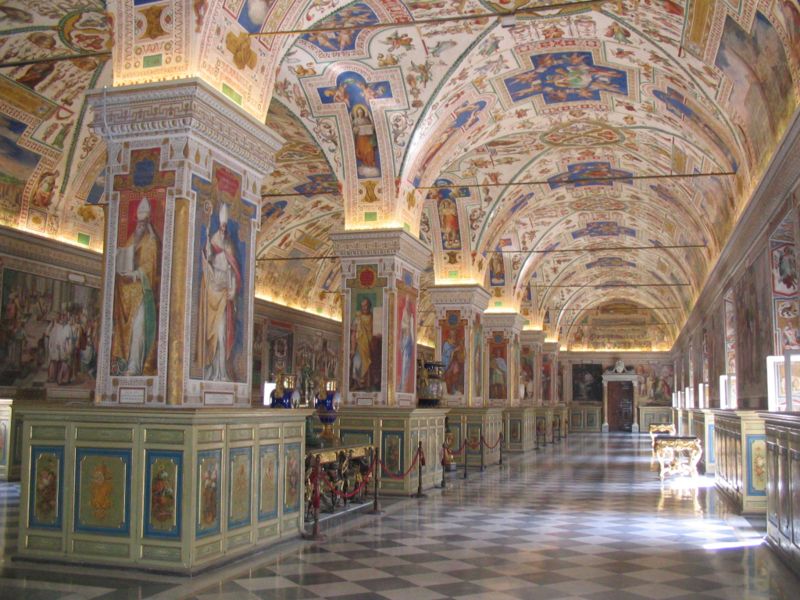
Last but not least, the Vatican Library is where any visitor can enjoy the beauty if the Sistine Chapel. The picture above shows only a part of it, can you imagine being able to see the whole every day? I wonder whether the scholars and archivists who work there every day are still amazed by the exquisite frescoes or if the novelty wears off eventually.
And now, if you have 12 minutes or so, here is the video I talked about in the beginning of this post. Enjoy!
Formally established in 1475, though in fact much older, the library contains approximately 2 million printed books and 80 thousand handwritten manuscripts in virtually every language known to man, a collection of ancient coins and so many other treasures that apparently nobody knows what exactly is there (sounds like they need a digital catalog). The contents of the library are the Pope's personal property and while scholars use the documents for their research only the Pope is allowed to borrow anything.
The Vatican Secret Archives is the central repository for all of the Holy See documents. In the 17th century, under the orders of Pope Paul V, the Secret Archives were separated from the Vatican Library, where scholars had some very limited access to them, and remained absolutely closed to outsiders until 1881, when Pope Leo XIII opened them to researchers, of whom now more than a thousand examine its documents each year. You might wonder why they're called "Secret" if everyone knows about them, and that would be because originally "secret" meant more "private" or "special" than "clandestine". Does have a nice ring to it though, doesn't it? I imagine if there are any UFO-related documents stored in Vatican they'd be hidden in the Secret Archives.
Last but not least, the Vatican Library is where any visitor can enjoy the beauty if the Sistine Chapel. The picture above shows only a part of it, can you imagine being able to see the whole every day? I wonder whether the scholars and archivists who work there every day are still amazed by the exquisite frescoes or if the novelty wears off eventually.
And now, if you have 12 minutes or so, here is the video I talked about in the beginning of this post. Enjoy!
Wednesday, February 1, 2012
Special Feature: Libraries of the Ancient World
When you're looking for information where do you first go? I'm betting it's not to the library. With a wealth of information on any given topic available online it's easy to dismiss the library altogether and as far as I'm concerned that is a crying shame. We can get everything scanned and converted into digital files and available at the click of a mouse but what about the sensory benefit of opening a beautifully-bound book for the first time, turning pages that are older than your parents, or even just walking among the stacks, breathing the air scented with paper and ink, and having a whimsically-colorful or gold-lettered spine catch your eye? I'm a huge fan of libraries (if you can't tell yet) and recently I've been thinking about the ones that were the beginning of it all. You know, the libraries in Celsus, Pergamum, Alexandria and a handful of other locations around the world where the enlightened and the curious came to learn.
We've all heard about the library of Alexandria, primarily because it was destroyed and there's not an architectural landmark we can visit, nothing to ground our imaginations in. There are historical records however that tell us about it. The library was charged with collecting all the world's knowledge and it was the first of its kind to gather a serious collection of books from beyond its country's borders. This collecting was very aggressive and involved seizing books from ships that came into the harbor and keeping the originals while returning copies to the original owners. It is impossible to say just how large the wealth of materials was at the library but according to legend Mark Antony gave Cleopatra the entire contents of the Library of Pergamum (200,000 scrolls) as a wedding gift, so if that was only a portion of the collection you can imagine the scope of the whole. The lore regarding the destruction of the library is conflicting but Plutarch wrote that during his visit to Alexandria in 48 BC Julius Caesar "accidentally" burned the library down when he set fire to his own ships to frustrate Achillas' attempt to limit his ability to communicate by sea.
The second largest Hellenistic library after Alexandria was the library of Pergamum, the city that gave the name to pergamus, or parchment, when it was invented to replace papyrus imported from Alexandria. Historical accounts claim that the library possessed a large main reading room, lined with many shelves. An empty space was left between the outer walls and the shelves to allow for air circulation. This was intended to prevent the library from becoming overly humid in the warm climate of Anatolia and can be seen as an early attempt at library preservation. Manuscripts were written on parchment, rolled, and then stored on these shelves. At the height of its cultural glory Pergamum was rivaled only by the cities of Alexandria and Antioch, now the ruins of the city and its library are major archaeological sites in Turkey.
The third great library of antiquity was the Library of Celsus, the smallest of the three (it was planned for only 12,000 scrolls, but unique because it was founded solely with the funds of the man it's named after. It is also unique because after it was destroyed by two earthquakes but was later partially restored. Now visitors can see the facade, which is believed to be a very accurate reproduction, and tour the partially-restored rest of the building. Another thing that makes this library unique is that Celsus was buried in a crypt under the library. At a time when even being buried within the city limits was unusual being buried within the library was a very special honor. I wonder if the crypt is still there, under the ruins...
We've all heard about the library of Alexandria, primarily because it was destroyed and there's not an architectural landmark we can visit, nothing to ground our imaginations in. There are historical records however that tell us about it. The library was charged with collecting all the world's knowledge and it was the first of its kind to gather a serious collection of books from beyond its country's borders. This collecting was very aggressive and involved seizing books from ships that came into the harbor and keeping the originals while returning copies to the original owners. It is impossible to say just how large the wealth of materials was at the library but according to legend Mark Antony gave Cleopatra the entire contents of the Library of Pergamum (200,000 scrolls) as a wedding gift, so if that was only a portion of the collection you can imagine the scope of the whole. The lore regarding the destruction of the library is conflicting but Plutarch wrote that during his visit to Alexandria in 48 BC Julius Caesar "accidentally" burned the library down when he set fire to his own ships to frustrate Achillas' attempt to limit his ability to communicate by sea.
The second largest Hellenistic library after Alexandria was the library of Pergamum, the city that gave the name to pergamus, or parchment, when it was invented to replace papyrus imported from Alexandria. Historical accounts claim that the library possessed a large main reading room, lined with many shelves. An empty space was left between the outer walls and the shelves to allow for air circulation. This was intended to prevent the library from becoming overly humid in the warm climate of Anatolia and can be seen as an early attempt at library preservation. Manuscripts were written on parchment, rolled, and then stored on these shelves. At the height of its cultural glory Pergamum was rivaled only by the cities of Alexandria and Antioch, now the ruins of the city and its library are major archaeological sites in Turkey.
The third great library of antiquity was the Library of Celsus, the smallest of the three (it was planned for only 12,000 scrolls, but unique because it was founded solely with the funds of the man it's named after. It is also unique because after it was destroyed by two earthquakes but was later partially restored. Now visitors can see the facade, which is believed to be a very accurate reproduction, and tour the partially-restored rest of the building. Another thing that makes this library unique is that Celsus was buried in a crypt under the library. At a time when even being buried within the city limits was unusual being buried within the library was a very special honor. I wonder if the crypt is still there, under the ruins...
Tuesday, November 22, 2011
Special feature: The Project MOBILIVRE
A while back somewhere online I saw a brief reference to Projet Mobilivre and the idea of a library in an Airstream trailer intrigued me. Must be something about that sleek silver shape packed with books traveling all over the North-American continent. So here's what I found on the project's website:
The projet MOBILIVRE-BOOKMOBILE project explores the long held tradition of bookmobiles as traveling libraries that promote the distribution of information.The BOOKMOBILE travels across the United States and Canada in a vintage airstream trailer visiting a variety of communities. Our annual traveling collection of approximately 300 book works range from handmade and one-of-a-kind to photocopied and small press publications.It looks like the project hasn't been on the road since 2005 so I hope it picks back up. Or may be they're just not posting updates?
Wednesday, October 26, 2011
Community Bookshelf in Kansas City
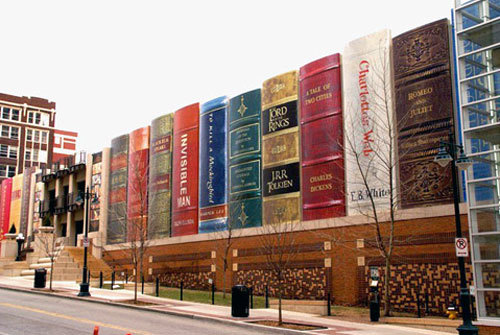
When you think of Kansas City, MO what's the first thing that comes to mind? I'm betting it's not the parking garage of their library. And that's a shame because it should. When the good people of Kansas City decided that the library needed more parking they came up with a unique way to make the new structure attractive as well as functional. The mural in the picture is actually the south wall of the Kansas City Public Library's parking garage, which in its entirety presents 22 titles that were suggested by Kansas City readers and then selected by The Kansas City Public Library Board of Trustees. The Community Bookshelf page on the library's website lists all the titles on the spines of the books and it's a pretty eclectic collection! I wonder whether the library saw an increase in patrons interested in checking out these titles once the mural was finished. The Romeo and Juliet cover is my favorite, must be the tooled leather and the combination of brown and gold. Which one do you like best?
Wednesday, September 28, 2011
World's Smallest Library
A little while ago I blogged about the largest library in the world, or should I say "libraries" because The British Library and the Library of Congress tied for the title. Today I decided to find out what the smallest library in the world is and guess what? The US and Great Britain tie again! In all fairness, had this idea occurred to me a month ago there wouldn't have even been a tie because the American contender didn't exist before the beginning of September and the concept is clearly borrowed from our friends across the Atlantic. But I should stop talking and introduce the winners:
Westbury Book Exchange is a traditional English telephone booth in the village of Westbury-sub-Mendip in Somerset, England that has been converted into a library and now houses over 100 books and music CDs. The villagers entered the idea into the British Telephone National competition and although they did not win the first prize they sure have received a lot of publicity since 2009 - their kiosk has been featured in many magazines, newspapers and blogs and BT even used a picture of it in their latest "Adopt a Kiosk" campaign brochure. The Book Exchange is free to use and anyone can take a book from the booth if they bring one to leave in its place. You can read more about the Westbury Book Exchange on the Westbury-sup-Mendip website.
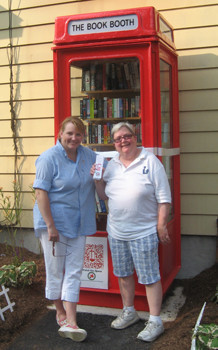
About two years after the residents of Westbury came up with their idea for repurposing a telephone booth Claudia Cooley of Clinton Corners, NY opened The Book Booth in her town with the help of Clinton Community Library in an effort to better reach the community. The kiosk is now officially the smallest library in America, it is open 24/7, 365 days a year, is never locked, has its own Facebook page and has also gotten plenty of publicity in the short time that it's been open. Read more about it in this Huffington Post interview.
Westbury Book Exchange is a traditional English telephone booth in the village of Westbury-sub-Mendip in Somerset, England that has been converted into a library and now houses over 100 books and music CDs. The villagers entered the idea into the British Telephone National competition and although they did not win the first prize they sure have received a lot of publicity since 2009 - their kiosk has been featured in many magazines, newspapers and blogs and BT even used a picture of it in their latest "Adopt a Kiosk" campaign brochure. The Book Exchange is free to use and anyone can take a book from the booth if they bring one to leave in its place. You can read more about the Westbury Book Exchange on the Westbury-sup-Mendip website.
About two years after the residents of Westbury came up with their idea for repurposing a telephone booth Claudia Cooley of Clinton Corners, NY opened The Book Booth in her town with the help of Clinton Community Library in an effort to better reach the community. The kiosk is now officially the smallest library in America, it is open 24/7, 365 days a year, is never locked, has its own Facebook page and has also gotten plenty of publicity in the short time that it's been open. Read more about it in this Huffington Post interview.
Wednesday, August 24, 2011
The Largest Library In The World
| Library of Congress |
| British Library |
For those curious enough to want to find out more about these two great libraries here are some links:
The official website of the Library of Congress
The LOC Wikipedia page
The official website of the British Library
The BL Wikipedia page
Thursday, July 28, 2011
Joe and Rika Mansueto Library
You're witnessing Bibliophile's Corner history in the making: this is my first ever late post. Had every intention of writing it, even drafted a portion, and then life happened and blogging had to be postponed. Thankfully all is well again and I'm eager to get back on schedule.
If you're wondering what in the world this picture has to do with libraries I'll tell you - it's the brand new book storage facility at the University of Chicago Joe and Rika Mansueto Library. All we hear these days is about libraries not being used, having their funding cut, closing or planning at least a partial conversion to e-books and electronic reference systems and here is a beautiful and heartening example of printed books not being discarded in favor of eInk displays but rather made even more easily accessible. At Mansueto up to 3.5 million volumes can be stored in bins in an underground vault of sorts with a 50 foot crane moving on tracks to retrieve the bin containing the book requested through an online system and deliver it to the ground level where the librarian will take out the needed volume and send the bin back to its designated spot in the vault. When the book is returned the librarian scans it into the system and the process repeats in reverse.
If you're wondering whether this really is more efficient than storing books in stacks we see in traditional libraries the answer is Yes. This storage system uses only 1/7 of the space that would've been taken up by stacks holding the same number of volumes and the whole retrieval process takes about 5 minutes (although the request system does indicate that the wait is 15 minutes I think they're erring on the side of caution there).
I love to see technology and old-fashioned learning coming together the way they do here and it was heartening to find out as I was reading up on this new library that Mansueto is not the only one where a high-density storage system such as this is used. It is the only one however with the book vault completely underground and as far as I understand it is the only one that utilizes the automatic storage and retrieval system the way they do.
If you're interested in learning more about this library visit its website here: http://mansueto.lib.uchicago.edu/. They have pictures, statistical data and information about the people who made this innovative library possible with their generous donation. There's even a great video showing the ASRS in action. Check it out!
If you're wondering what in the world this picture has to do with libraries I'll tell you - it's the brand new book storage facility at the University of Chicago Joe and Rika Mansueto Library. All we hear these days is about libraries not being used, having their funding cut, closing or planning at least a partial conversion to e-books and electronic reference systems and here is a beautiful and heartening example of printed books not being discarded in favor of eInk displays but rather made even more easily accessible. At Mansueto up to 3.5 million volumes can be stored in bins in an underground vault of sorts with a 50 foot crane moving on tracks to retrieve the bin containing the book requested through an online system and deliver it to the ground level where the librarian will take out the needed volume and send the bin back to its designated spot in the vault. When the book is returned the librarian scans it into the system and the process repeats in reverse.
If you're wondering whether this really is more efficient than storing books in stacks we see in traditional libraries the answer is Yes. This storage system uses only 1/7 of the space that would've been taken up by stacks holding the same number of volumes and the whole retrieval process takes about 5 minutes (although the request system does indicate that the wait is 15 minutes I think they're erring on the side of caution there).
I love to see technology and old-fashioned learning coming together the way they do here and it was heartening to find out as I was reading up on this new library that Mansueto is not the only one where a high-density storage system such as this is used. It is the only one however with the book vault completely underground and as far as I understand it is the only one that utilizes the automatic storage and retrieval system the way they do.
If you're interested in learning more about this library visit its website here: http://mansueto.lib.uchicago.edu/. They have pictures, statistical data and information about the people who made this innovative library possible with their generous donation. There's even a great video showing the ASRS in action. Check it out!
Wednesday, June 29, 2011
The Morgan Library & Museum, New York, NY
The first time I ever heard about this library was by absolute accident: fellow subscribers of a mailing list were discussing what to do on a visit to NYC and someone recommended The Morgan saying that there are manuscripts by Jane Austen and Charlotte Bronte and Charles Dickens there, among others. So of course I had to know more and the more I learned the more I wanted to go there immediately and look at all the treasures with my own eyes.
The library was founded in 1906 to house the private library of J.P. Morgan and was made a public institution by his son in 1924. It is now a museum and research library and houses priceless manuscripts, diaries, correspondence and books from all over the world.
Here's what's there, from the library's website:
The library was founded in 1906 to house the private library of J.P. Morgan and was made a public institution by his son in 1924. It is now a museum and research library and houses priceless manuscripts, diaries, correspondence and books from all over the world.
Here's what's there, from the library's website:
A centerpiece of his collection was—and still is—the sole surviving manuscript of John Milton's Paradise Lost, transcribed and corrected under the direction of the blind poet. Other collection highlights are Charles Dickens's manuscript of A Christmas Carol, Henry David Thoreau's journals, Thomas Jefferson's letters to his daughter Martha, and manuscripts and letters of Jane Austen, Charlotte Brontë, Lord Byron, Wilkie Collins, Albert Einstein, John Keats, Abraham Lincoln, and John Steinbeck.I could go on and on but I really want to go back to the website and explore some more so that when I finally get there some day I'd know my way around and won't completely fangirl over Jane Austen's manuscripts. Hopefully.
[...]
The Morgan's collection of literary and historical manuscripts has been enriched by many gifts and acquisitions, and twentieth-century holdings have increased significantly. The collection, particularly strong in artists' letters, was greatly enhanced by the Pierre Matisse Gallery Archives, the gift of the Pierre Matisse Foundation in 1997. These archives include more than fifteen hundred letters as well as records of the gallery installations of Balthus, Chagall, Dubuffet, Giacometti, Miró, and other twentieth-century artists. The Carter Burden Collection of American Literature includes important manuscripts and correspondence of John Cheever, Ezra Pound, and Tennessee Williams. The 1999 acquisition of The Paris Review Archive added correspondence, interviews, typescripts, and revised proofs of several hundred post-World War II writers, including Donald Hall, Ernest Hemingway, Jack Kerouac, Norman Mailer, Toni Morrison, George Plimpton, Philip Roth, and Anne Sexton.
[...]
The [Printed Books and Bindings] collection's strong base derives from the major acquisitions of Pierpont Morgan, who sought to establish in the United States a library worthy of the great European collections. It is rich in special and unique copies, first editions of classical authors, and works of notable printers, such as Jenson and Caxton. Among the highlights are three Gutenberg Bibles, a strong collection of works by Lord Byron, Charles Dickens, Edgar Allan Poe, John Ruskin, Mark Twain, Herman Melville, and William Morris, and classic early children's books. The Carter Burden Collection of American Literature, a major 1998 gift, strengthens the Morgan's twentieth-century holdings with authors such as Ted Hughes, Sylvia Plath, Vladimir Nabokov, Gertrude Stein, and Tennessee Williams.
Wednesday, April 27, 2011
The Oldest Libraries In The World
One of my favorite places to be is at a library. It's quiet, it smells like books, it's orderly and there's adventures and knowledge all around, with shelves so tall you need a ladder to reach the volumes at the very top. It hasn't always been like that. In the early days monasteries painstakingly built their collections one hand-copied volume at a time and often their entire wealth of knowledge could fit in one trunk. Here are 10 libraries that are still operating, some contain texts dating to 300s AD. Not all are open to the public, but they're there, preserving the knowledge of the centuries.

Source
Bibliotheque Nationale de France in Paris, France
The National Library of France traces its origin to the royal library founded at the Louvre by Charles V in 1368. It expanded under Louis XIVand opened to the public in 1692. (Source)
Redwood Library in Newport, Rhode IslandFounded in 1747, it is the oldest community library still occupying its original building in the United States. (Source) 
Source Vatican Library in Rome, Italy Pope Nicholas V established the library in the Vatican in 1448 by combining some 350 Greek, Latin and Hebrew codices inherited from his predecessors with his own collection and extensive acquisitions, among them manuscripts from the imperial Library of Constantinople. The Biblioteca Apostolica Vaticana was established in 1475. (Source) 
Source Al-Karaouine University Library in Fez, Morocco (also spelled as Al-Qairawān, Al-Qarawiyin or Al-Qarawiyyin) The Al-Karaouine madrasa is part of a mosque, founded in 859 by Fatima al-Fihri, the daughter of a wealthy merchant named Mohammed Al-Fihri. It gained the patronage of politically powerful sultans and compiled a large selection of manuscripts that were kept at a library founded by the Marinid Sultan Abu Inan Faris in 1349. (Source) 
Source Bodleian Library in Oxford, England Bodleian Library, in its current incarnation, has a continuous history dating back to 1602, its roots date back even further. The first purpose-built library known to have existed in Oxford was founded in the fourteenth century (Source) 
Source
The library at St. Catherine's Monastery at Mount Sinai, Egypt
The oldest record of monastic life at Sinai comes from the travel journal written in Latin by a woman named Egeria about 381-384. [...] The monastery library preserves the second largest collection of early codices and manuscripts in the world, outnumbered only by the Vatican Library. (Source)Source
Bibliotheque Nationale de France in Paris, France
The National Library of France traces its origin to the royal library founded at the Louvre by Charles V in 1368. It expanded under Louis XIVand opened to the public in 1692. (Source)
Source
Library Company in Philadelphia, Pennsylvania

SourceLibrary Company in Philadelphia, Pennsylvania
Founded in 1731 by Benjamin Franklin as a library, the Library Company of Philadelphia has accumulated one of the most significant collections of historically-valuable manuscripts and printed material in the United States. (Source)
Redwood Library in Newport, Rhode Island
Subscribe to:
Posts (Atom)