Sunday, June 23, 2013

Review: Bartleby the Scrivener by Herman Melville

When the proprietor of a law office in New York hires a new clerk for his practice he seems to have found a colorful yet beneficial addition for his already colorful team. But when the new employee begins to inform the proprietor that he "would prefer not to" perform his duties things get really interesting.

I have heard about this book from a friend of mine, who's read it with her book club, so I generally knew what to expect in terms of plot developments. I was however pleasantly surprised by the characters in this novella. They were all remarkable in one way or another and since they were all very distinct their differences stood out all the more. It seems that authors in the middle of the 19th century weren't afraid to make their characters full of personality, take Dickens for example, and Melville definitely followed the same tradition. I particularly enjoyed the character of the proprietor, who is the narrator of this story. He tries so hard to be on good terms with all of his employees, regardless of the trouble they cause him, and makes up excuses to not take any action that would make him look good in his own eyes.
What I didn't expect is how plodding the pace is. Now that I've read Benito Cereno I think that's something that is common in Melville's work. The same type of scene seemed to repeat over and over without furthering the plot or developing the characters. The only thing this repetition seemed to accomplish was to convince me further of utter and complete spinelessness of the proprietor, but I already knew that so it wore on me. I did enjoy the ending though. It seemed somewhat abrupt because events moved along faster than the rest of the story but it was very satisfying. In a way it was the only appropriate ending, anything else wouldn't have worked quite as well. It also redeemed the proprietor in my eyes somewhat, he did have a good heart even if his will was lacking. Despite the extremely slow middle of the novella the ending saved it for me and for a few days after finishing it I kept thinking about the characters and the story. I can see why Melville is considered such an important figure in American literature and why this particular piece is still widely read. I would recommend Bartleby if you want to read a work that will inspire you to think about people, their motivations and how they relate to each other.

Sunday, June 16, 2013

Review: Funny In Farsi by Firoozeh Dumas

Funny in Farsi chronicles the American journey of Dumas’s family and Firoozeh herself, who as a girl changed her name to Julie, and who encountered a second wave of culture shock when she met and married a Frenchman, becoming part of a one-couple melting pot.

When my book club voted for this book to be on our list for this year I was excited: it was definitely different from our usual fare and it was a promise of a peek into a new cultural experience, which is always something I'm interested in (since I myself am an immigrant other immigrant experiences are something I'm curious about). Besides, the title has the word "Funny" in it, I expected humor and lots of it.
The book started out well enough and at first I could see myself finishing it, but then it took a turn for the worse. It is structured as a series of vignettes covering particular subjects such as doing touristy things in America, kindness of strangers, American food, camp experience, etc. They're not done in any kind of chronological order and one chapter can jump from childhood to adulthood in a paragraph or two. This made it difficult for me to enjoy the experience because I couldn't help but feel unfocused and scattered all over the author's life. The promised humor was there but it was mild and didn't make me chuckle even once.
I got through about a third of the book and realized that I was having an OK experience with it but I didn't really care one way or another what else the author was going to talk about. My main takeaway at that point was that she didn't particularly feel like she belonged in either her family because she grew up very Americanized nor in American society because of her name, appearance and heritage, but she was putting a brave face on it. I also think she possibly was hoping that this book would build a bridge of sorts between the cultures, show the Western world that Iranians are not all terrorists and the Persian world that all Americans don't hate them just because they're Muslim. The fact that this book was written and published after the 9/11 makes this idea plausible for me.
I really wanted to like this book but once I realized it didn't really work for me I set it aside. Life is too short for OK books, especially if they're not required reading (I'm looking at you, Manon Lescaut and Bartleby the Scrivener), even if intentionally or not they make "the other" seem not quite so alien.

Sunday, June 9, 2013

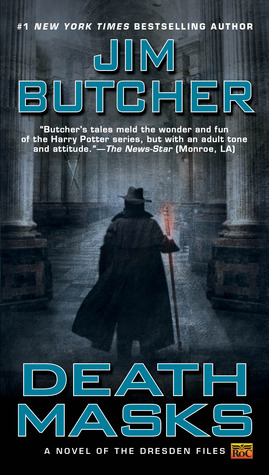
Review: Death Masks by Jim Butcher

Harry Dresden, Chicago’s only practicing professional wizard, should be happy that business is pretty good for a change. But now he’s getting more than he bargained for. A duel with the Red Court of Vampires’ champion, who must kill Harry to end the war between vampires and wizards… Professional hit men using Harry for target practice… The missing Shroud of Turin… A handless and headless corpse the Chicago police need identified… Not to mention the return of Harry’s ex-girlfriend Susan, who’s still struggling with her semivampiric nature. And who seems to have a new man in her life. Some days, it just doesn’t pay to get out of bed. No matter how much you’re charging.

I first picked up this series because I watched the TV show which is based on the books and wanted more of Harry Dresden and his supernatural adventures. Sadly the show only lasted for one season, which is not that surprising if you consider that cool shows get canceled sooner than they should be and we end up with naked people covered in bodily fluids prancing around on the screen. But I digress. I read the first three books and could tell that they were a promise of better things to come. I was right. Book 4, Summer Knight, finished setting up the world and established the over-arching conflicts for the future installments (the wizard-vampire war and Harry's troubled personal life) as well as the mystery of Harry's parents' lives and deaths. At that point I felt that Butcher was done flexing his writerly muscles and was finally getting to the meat of things, while at the same time the day-to-day wizardly detective work was not going anywhere. I really like this about these books, by the way, there's always a more short-term problem to solve while the big-deal problem demands attention at the same time. Back to the book at hand though.
I was right about the meat of things. Death Masks builds on the conflicts, with some steamy and deadly consequences, and feeds us a pellet of information about Harry's mom. He is either too busy or too reluctant to pursue this tidbit, conceivably because he is afraid of what he might discover. Yes, I'm talking about feelings while discussing a high-action urban fantasy with death waiting at almost every page. There's quite a bit of that in this book, actually. Soul-searching, self-analysis, reflection, Harry does all that, and it balances the near-constant action. It provides for some down time while still allowing for things to happen, as it does perfectly when Harry has a heart-to-heart with Michael's wife. This is one of my favorite scenes in the book, by the way. Another means of tension relief is the humor which permeates this book and the rest of the series. Harry is a really self-deprecatingly witty guy! I chuckled on so many occasions that my husband started raising his eyebrows in my direction. I ignored the eyebrows and kept reading.
We've already met all the key players of the series so Butcher's main task here is to develop their character arcs. I really liked that Susan didn't just move to the beach to suppress her vampiric tendencies, she is no damsel in distress and in this book we really get to see her in action. It doesn't hurt that she has an ace up her sleeve either. Gentleman Johnny Marcone (I love how Harry always refers to him in this way, no exceptions) is a very interesting guy and I look forward to seeing where Butcher takes his character.
I didn't expect any surprises in this book but there was one: by now I'm used to Harry getting pummeled into hamburger in the course of the novel and then having to go fight The Fight severely sleep-deprived and broken. Not in this novel. I won't go into details but the way things worked out was very refreshing and satisfying. I wonder what Butcher will do in the next novel. Maybe if I can stop taking on commitments like I have something against sleep I'll even find out, soonish.

Sunday, June 2, 2013

Review: Manon Lescaut by Abbé Prévost

"The sweetness of her glance - or rather, my evil star already in its ascendant and drawing me to my ruin - did not allow me to hesitate for a moment..." So begins the story of Manon Lescaut, a tale of passion and betrayal, of delinquency and misalliance, which moves from early eighteenth-century Paris - with its theatres, assemblies, and gaming-houses - via prison and deportation to a tragic denouement in the treeless wastes of Louisiana. It is one of the great love stories, and also one of the most enigmatic: how reliable a witness is Des Grieux, Manon's lover, whose tale he narrates? Is Manon a thief and a whore, the image of love itself, or a thoroughly modern woman?

Remembering how intense my last Coursera experience was, what with needing to read a novel a week and do plenty of other related work I decided to give myself a head start on the Fiction of Relationships curriculum. Manon Lescaut will be the first novel we'll be covering and I'm glad I wasn't restricted in time when I read it. No, it's not long and it doesn't place any serious demands on the reader's faculties, but it does tax one's patience. At least it did that to mine.
It took me a while to get into the story because it is told in a very old-fashioned way, it begins at the end, then jumps to the beginning and works its way to the end again; it is also the perfect example of the author telling much more than showing. I did my best to remember that if this book is on the curriculum of a Brown University course there must be value in it, so I read closely in an effort to not miss this value among all the exceedingly flowery phrases and moralizing debates on the subjects of love and virtue. See, I read so closely that the floweriness has seeped into my brain! But I digress. I kept thinking that if nothing else this book provides an excellent example of how literature has changed since the 1700s and how I needed to pay attention to the relationships described in the novel since that will be the focus of the course. And then something curious happened: as irritated as I was by Manon's flightiness and Grieux's lack if backbone, as well as the archaic language, I soon found that the characters weren't entirely unsympathetic and began reflecting on all the reckless and crazy things people do in the name of love. Somehow this novel broke through the frustration and touched me.
This realization alone surprised me to no end and I continued reading with a certain degree of enjoyment. Imagine my surprise when I finished the book, looked it up online, and found that Manon Lescaut isn't as obscure as I imagined. Authors of novels hailed as classics referenced it in their work, it continues to inspire composers and dramatists, it is the subject of quite a few academic papers and it's still being published with the latest edition released in 2005! (Don't you just love Wikipedia?)
In the end although I wouldn't recommend this novel to a friend in search of an engaging and fun read I'm glad I read it, if purely because it's widened my literary horizons and showed that love has always been blind and young people have always been capable of highly imprudent behavior. It's human nature, after all!

Sunday, May 26, 2013

Review: The Spy Who Came In From The Cold by John le Carré

When the last agent under his command is killed and Alec Leamas is called back to London, he hopes to come in from the cold for good. His spymaster, Control, however, has other plans. Determined to bring down the head of East German Intelligence and topple his organization, Control once more sends Leamas into the fray - this time to play the part of the dishonored spy and lure the enemy to his ultimate defeat.

The first time I became interested in John le Carré's work was when Tinker Tailor Soldier Spy with Benedict Cumberbatch was advertised prior to its release. I'm a huge fan of Cumberbatch (or The Batch, as he is affectionately known) whose Sherlock won me over, and curious about the movie I suggested the book for my book club's reading list. Majority asked for a more famous novel by le Carré so here we are.
It is easy to understand why this book has stood the test of time: it is a fast-paced, intelligent, emotionally-engaging thriller with characters who are easy to care about and even the shift of perspective from what I would describe as "inner circle third person" to "outsider third person", which was quite obvious, didn't change that. I think le Carre employed this device to hide certain things from the reader without making Leamas an unreliable narrator. He was counting on the reader to figure out what was really happening as the novel progressed and with the little hints along the way it wasn't that hard. The book could've become boring at that point considering that the action isn't in chases or gun-fights but in a steady execution of the plan, but le Carre had an ace up his sleeve. With the perspective back to "inner circle third person" the reader got to realize along with Leamas that he wasn't as inner circle as he thought he was. A three-level conspiracy, my friends, how delicious is that?! I won't say more for the sake of not spoiling the ending, but you see how this book is never exactly what it seems at first, with characters pursuing secret agendas to the very end.
Written in the middle of the Cold War and being a spy thriller it is no surprise that this book pits characters who are both physically and figuratively on different sides of the Berlin wall against each other. Le Carre talks ideology here and doesn't leave any room for doubt as to which side he is on. I don't know how historically accurate the details are and the year on the calendar didn't allow for ambiguity if one wanted to be published and widely read, but the fact remains. While there aren't any gray areas as far as le Carre's and Leamas' allegiances go there are plenty of them in the rest of the novel. I suppose it is like that in the business of spying where the ends justify whatever means necessary. As Leamas said, the only criteria of success is results, and ethics are sacrificed at every turn.
The most memorable and thought-provoking character for me was Liz, particularly because little about her is straightforward. She is young, naive and idealistic but she is locked in a gray area even more so than the spies who've made it their home. She belongs to the Communist Party yet she dislikes its everyday defining characteristics, she sees a socialist state first-hand yet she doesn't question her beliefs, she rejects the capitalist ideals yet she is devoted to a man who is as ideologically far from her as possible. She gives the depth and the heart to this novel, particularly by showing Leamas the man underneath the mask of the spy and making the reader care for those who at the end of the day are collateral in the game of politics.
This book was published almost 40 years ago and is set even earlier but it doesn't read as dated. In fact, if I didn't know when it was written I would've taken it for a historical spy thriller. Now I'm even more curious about Tinker Tailor Soldier Spy because I am confident that le Carre knows what he is doing so expect to see me talking about it here at some point in the future.