Showing posts with label Historical Fiction. Show all posts

Saturday, April 12, 2014

Review: Liars and Saints by Maile Meloy

Set in California, this novel follows four generations of the Catholic Santerre family from World War II to the present. In a family driven as much by jealousy and propriety as by love, an unspoken tradition of deceit is passed from generation to generation. When tragedy shatters their precarious domestic lives, it takes courage and compassion to bring them back together.

Very slowly I'm getting back to reading, and tackling this month's book club read on audiobook seemed like the best way to get it read (my track record this year has been far from stellar). Audiobook proved to be an excellent choice, and Liars and Saints a great book to ease me back into the world of fiction.
It can be difficult to create character voices that are easy to distinguish, and most authors limit themselves to two, maybe three points of view per book for that exact reason. Maile Meloy went all in with her debut novel: she has seven. Moreover, these seven characters grow and change as the story progresses, and their voices change with them, never losing their individuality. That was actually my favorite thing about this book, how well the author wrote her characters and their imperfections, self-doubts, courage and faith. They kept me listening, and that is what ultimately counts as far as characters go.
This book was short-listed for the Orange Prize in 2005, and while I can see why it went as far as to be short-listed I also see why it did not win. The plot is to blame, particularly two aspects of it. One came about half-way through and it required me to suspend my disbelief a bit too much. Had it been omitted I wouldn't have minded, in fact, it would have kept me more grounded in the story. The second time the plot development didn't work for me was toward the end of the book, and this time it seemed like a cop-out that forced the story toward resolution. I haven't read very many novels that tell about several generations of a family, so I can't give examples of ones where similar situations would've been handled better, I just know that the way Meloy wrapped up her book didn't work all that well for me. (You have no idea how hard it is to abide by my own no-spoilers policy right now.)
When cover copy tells you that this is a story of a family with a history of deception you begin reading with the expectation of wowza moments. If there are no such moments then what's the point of telling such a story, right? Well, let me tell you, there is a wowza moment alright. When I first realized where the author was going I was sure she wasn't going to actually go there. But she did. All the way. It's quite a shocker, and I can't tell you want it was, but it made me post on FB and Twitter that I was suitably shocked. (Don't you wish right now I didn't have a no-spoilers policy?)
If you are looking for a novel that's a quick read, has rich characters and a plot that at times approaches the twists and turns of a daytime soap opera this book is for you!

Sunday, August 18, 2013

Review: Beloved by Toni Morrison

Sethe was born a slave and escaped to Ohio, but eighteen years later she is still not free. She has too many memories of Sweet Home, the beautiful farm where so many hideous things happened. And Sethe's new home is haunted by the ghost of her baby, who died a violent death and whose tombstone is engraved with a single word: Beloved.

My first experience with Toni Morrison's writing was in college when the professor assigned The Bluest Eye. I don't remember much about the plot, but I do remember that it made me feel like I was in the presence of a literary great. The quality of writing was superb and even after reading a number of wonderful books that semester The Bluest Eye impressed me most. Fast forward to this year, when I first saw that Beloved was on the Fiction of Relationship reading list. I knew I was in for a treat yet at the same time I was not sure that the book would live up to my inflated expectations. When the time came to actually read it I was relieved to see that Morrison is consistent in her ability to impress me. Her prose is beautiful in its simplicity, her characters full of life. She simply tells the story and you can't help but care about the people in it, can't help but wonder what will happen next. She doesn't try to make you like her characters, they are who they are with their complicated lives and choices, but you care about them nonetheless. The character who made the biggest impression on me was Denver because she not only had a unique way of dealing with the difficulties her life presented, but she also was the one who stepped up to the challenge of Beloved's presence in the most impressive way. She started out a child younger than her 18 years, yet at the close of the novel she was transformed into a young woman mature beyond her years.
The novel is set in the South before and after the Civil War and tells the stories of Sethe and other former Sweet Home slaves as they build lives for themselves on and off the farm. Their experiences, their desires and their despair are highlighted all the more by our present lives and the fact that many of the events Morrison describes are unthinkable to the present-day reader. They seem almost surreal in their realism, and I had to remind myself that things like what Morrison talks about did happen, and not that long ago.
I believe that a sign of a good book is that it makes you think. More often than not such books don't go down smoothly, but they sure stay with you. They make you want to ponder what's said on those pages, revisit ideas and impressions, look back at the beliefs you hold and see if they still hold up. Beloved does that, and no, it's not an easy read. Not only is it not easy, it also doesn't give up all its secrets, not even at the very end. You can turn the last page and believe what you choose about Beloved because her story doesn't really have an ending, which to me is incredibly intriguing. How do you write a story where the same events can be both supernatural and perfectly explainable? How do you create characters who are both flesh and blood and the product of superstition? I don't know if Morrison's is the only way, but it sure is effective.
I've been thinking for a several days now whether I would recommend this book to a friend and I can't come up with a an answer. On one hand it's not a straightforward book and I don't believe that someone who's looking for a straightforward story would appreciate it. On the other hand it is so well-written that I'm tempted to insist that my friends read it. So my answer would be like that flow-chart, Are you looking for a simple escapist story? Then no, you won't enjoy this novel. Are you looking for something to feed your brain and be beautiful at the same time? Then yes, this novel is for you.

Sunday, July 14, 2013

Review: The Secret Keeper by Kate Morton

During a party at the family farm in the English countryside, sixteen-year-old Laurel Nicolson has escaped to her childhood tree house and is dreaming of the future. Before the afternoon is over, Laurel will witness a shocking crime that challenges everything she knows about her family and especially her mother, Dorothy.
Now, fifty years later, Laurel is a successful and well-regarded actress, living in London. She returns to the family farm for Dorothy’s ninetieth birthday and finds herself overwhelmed by questions she has not thought about for decades. From pre-WWII England through the Blitz, to the fifties and beyond, discover the secret history of three strangers from vastly different worlds — Dorothy, Vivien, and Jimmy — who meet by chance in wartime London and whose lives are forever entwined.

I've heard a lot of good things about Kate Morton's books so when I was putting together my reading list for this year I was excited to include The Secret Keeper. I did not regret my choice when I finished reading the book, particularly because Morton is so very good at bringing her characters to life.
Everybody we meet in the course of the novel is flawed or broken in some way: Laurel is wed to her work and a secret that's older than she is, Dorothy's desire for something more and better rules her life, Vivien is a prisoner of her past, Jimmy sacrifices his beliefs for the sake of love... There is a story there for each of these characters and through them Morton weaves a tale of love, family, growing up, hard choices and decisions with far-reaching consequences.
It's fortunate that the characters are strong because the biggest mystery in the book wasn't all that mysterious for me. I guessed what would be the shocker about half way through and kept reading mainly to see whether I was right and to watch the characters get to the end of the story. Morton worked very hard on making the shocker plausible and on keeping the reader in the dark throughout the book, and yet it wasn't seamless (Gillian Flynn managed to keep me guessing much better in Gone Girl). There were key character traits that just didn't work with the ending, and remembering how highlighted they were made the dissonance only more obvious for me.
Despite this shortcoming reading The Secret Keeper was particularly enjoyable because of the writing. The book is full of lines that I wanted to write down and commit to memory, but for the fear of breaking the spell I didn't, and now that the book is back at the library I wish I had. Fortunately there is the Internet, so here are a couple of quotes that I liked so much I went back to reread them once I was done with the chapters where they appear:
"... people who'd led dull and blameless lives did not give thanks for second chances."
and this paragraph I thought was just beautifully written, with a sprinkling of foreshadowing and a generous doze of significance:
"And as the train whistled its imminent departure, a small girl wearing neat plaits and someone else's shoes climbed its iron stairs. Smoke filled the platform, people waved and hollered, a stray dog ran barking through the crowds. Nobody noticed as the little girl stepped over the shadowed threshold; not even Aunt Ada, who some might've expected to be sheperherding her orphaned niece towards her uncertain future. And so, when the essence of light and life that had been Vivien Longmeyer contracted itself for safekeeping and disappeared deep inside her, the world kept moving and nobody saw it happen."
I did enjoy this book and if you are a fan of lyrical prose and a character-driven story I think you will as well. For my part, I'll be keeping an eye on Morton's new books. She's liable to produce another beautiful novel (hopefully one with a more graceful surprise of an ending).

Sunday, May 26, 2013

Review: The Spy Who Came In From The Cold by John le Carré

When the last agent under his command is killed and Alec Leamas is called back to London, he hopes to come in from the cold for good. His spymaster, Control, however, has other plans. Determined to bring down the head of East German Intelligence and topple his organization, Control once more sends Leamas into the fray - this time to play the part of the dishonored spy and lure the enemy to his ultimate defeat.

The first time I became interested in John le Carré's work was when Tinker Tailor Soldier Spy with Benedict Cumberbatch was advertised prior to its release. I'm a huge fan of Cumberbatch (or The Batch, as he is affectionately known) whose Sherlock won me over, and curious about the movie I suggested the book for my book club's reading list. Majority asked for a more famous novel by le Carré so here we are.
It is easy to understand why this book has stood the test of time: it is a fast-paced, intelligent, emotionally-engaging thriller with characters who are easy to care about and even the shift of perspective from what I would describe as "inner circle third person" to "outsider third person", which was quite obvious, didn't change that. I think le Carre employed this device to hide certain things from the reader without making Leamas an unreliable narrator. He was counting on the reader to figure out what was really happening as the novel progressed and with the little hints along the way it wasn't that hard. The book could've become boring at that point considering that the action isn't in chases or gun-fights but in a steady execution of the plan, but le Carre had an ace up his sleeve. With the perspective back to "inner circle third person" the reader got to realize along with Leamas that he wasn't as inner circle as he thought he was. A three-level conspiracy, my friends, how delicious is that?! I won't say more for the sake of not spoiling the ending, but you see how this book is never exactly what it seems at first, with characters pursuing secret agendas to the very end.
Written in the middle of the Cold War and being a spy thriller it is no surprise that this book pits characters who are both physically and figuratively on different sides of the Berlin wall against each other. Le Carre talks ideology here and doesn't leave any room for doubt as to which side he is on. I don't know how historically accurate the details are and the year on the calendar didn't allow for ambiguity if one wanted to be published and widely read, but the fact remains. While there aren't any gray areas as far as le Carre's and Leamas' allegiances go there are plenty of them in the rest of the novel. I suppose it is like that in the business of spying where the ends justify whatever means necessary. As Leamas said, the only criteria of success is results, and ethics are sacrificed at every turn.
The most memorable and thought-provoking character for me was Liz, particularly because little about her is straightforward. She is young, naive and idealistic but she is locked in a gray area even more so than the spies who've made it their home. She belongs to the Communist Party yet she dislikes its everyday defining characteristics, she sees a socialist state first-hand yet she doesn't question her beliefs, she rejects the capitalist ideals yet she is devoted to a man who is as ideologically far from her as possible. She gives the depth and the heart to this novel, particularly by showing Leamas the man underneath the mask of the spy and making the reader care for those who at the end of the day are collateral in the game of politics.
This book was published almost 40 years ago and is set even earlier but it doesn't read as dated. In fact, if I didn't know when it was written I would've taken it for a historical spy thriller. Now I'm even more curious about Tinker Tailor Soldier Spy because I am confident that le Carre knows what he is doing so expect to see me talking about it here at some point in the future.

Sunday, May 12, 2013

Review: The Cat's Table - Michael Ondaatje

In the early 1950s, an eleven-year-old boy boards a huge liner bound for England – a ‘castle that was to cross the sea’. At mealtimes, he is placed at the lowly ‘Cat's Table’ with an eccentric group of grown-ups and two other boys, Cassius and Ramadhin. As the ship makes its way across the Indian Ocean, through the Suez Canal, into the Mediterranean, the boys become involved in the worlds and stories of the adults around them, tumbling from one adventure and delicious discovery to another, ‘bursting all over the place like freed mercury’. And at night, the boys spy on a shackled prisoner – his crime and fate a galvanizing mystery that will haunt them forever.

The most powerful feature of this book for me is how poetic the language is. The lyricism of it, the almost dreamy quality of the narrative make this novel an experience of poetry in prose and the character's voyages throughout the book only become richer for it.
The novel's protagonist, Michael, tells the reader about the trip that changed his life both literally and figuratively when he was only 11 years old, although I didn't get a feeling that it was a journey of self-discovery in any sense. The boy simply experiences the adventures of the voyage and the adult reminisces about them and the events that followed, in a way wrapping things up for the characters, telling the reader where they ended up and how. Curiously enough the adult Michael is a writer, and Ondaatje himself arrived in England from Colombo when he was 11 on a ship called the Oronsay, just like the boy in the novel does. There is some speculation about whether the novel is autobiographical in a lot of ways and although the author hasn't confirmed or denied this I am inclined to believe that it is indeed autobiographical, however fictionalized and dramatized, especially in terms of a child experiencing life without direct adult influence and an adult fully understanding the real impact and meaning of those childhood experiences.
Michael's story is intertwined with stories of other passengers, many of whom aren't who they seem to be at first and whose presence makes for a multi-layered narrative. This reminded me of The Shadow of the Wind by Carlos Ruiz Zafon, who employs a similar story-within-a-story structure, and if you've been following the blog you'll remember that I enjoyed that book a lot. My favorite story-in-a-story was that of Miss Lasqueti, I found it even more touching and fascinating than that of the prisoner. Possibly that's because it is more subtle, there is no life or death drama and secrets in it, yet it got to me and made me think about the events of Miss Lasqueti's life and their undeniable effects.
There is quite a bit of jumping back and forth in time so if you usually have trouble with that - be prepared. It wasn't a problem for me at all, I actually enjoyed it because it gave the story a more mature feeling, clarified in a way why the 11-year-old protagonist didn't seem exactly pre-teen. After all it is an adult looking back through time at the child, reliving the experiences through the memories, offering insight that he wouldn't have had all those years ago.
This was one of the books I listened to as opposed to reading, and although having the author do the narration was very special because I knew that the intonations, pauses and pronunciations were done exactly as intended I think this is a book that should be read, be that on paper or eReader, especially if you are a person whose visual perception is better than audio perception. As I've mentioned before the writing is extremely beautiful and if you look up quotes from this book online you'll see exactly what I mean. I myself will be picking up this book again, this time soaking it all in from the page.

Monday, February 11, 2013

Review: Sweetness at the Bottom of the Pie by Alan Bradley

For Flavia, an aspiring 11-year-old chemist with a passion for poison, life begins in earnest when murder comes to Buckshaw. To her the investigation is the stuff of science: full of possibilities, contradictions, and connections. Soon her father, a man raising his three daughters alone, is jailed for murder. He tells Flavia an astounding story of a schoolboy friendship turned ugly, a stolen priceless object, and a Latin teacher who flung himself to his death from the school tower thirty years before. Flavia ties tie two distant deaths together, examines new suspects, and follows the search to the King of England himself.

For a book published in 2009 this novel is remarkably like the cozy mysteries Agatha Christie wrote in tone, voice, and the nature of the crime: a stranger is found dead at an English country estate and an amateur investigates the death leaving the police in the dust. What's different about this book is that the amateur is an 11-year-old prodigy chemist in pigtails.
From the very first page the author grabbed my interest by diving straight into the mystery of the victim in the closet and held me captive till the end by introducing mystery after mystery with one common denominator: they were all not at all what they seemed. A mystery novel is of course all about the mystery and this one kept me wondering for most of the book. I figured out the culprit not too long before Flavia did and so the story remained interesting while the investigation was going on.
A fun twist is that this is a historical novel and to me the author translated the tone of the time and place to the page very well. I enjoyed reading about listening to music on a gramophone, researching information in 20-year-old newspapers and figuring out details about people and places through old-fashioned face-to-face conversation. Things like that transported me to times long past and I relished the experience because of the contrast with our technology-saturated present. There is just something positively quaint about the concept of investigating the case of a body in the cucumber patch.
This novel is full of interesting characters and Flavia, the protagonist, is the most interesting of them all. Half the time she doesn't seem like an 11-year-old at all, what with her independence and prowess in chemistry, and sometimes it seemed too much, but then she'd do something utterly age-appropriate and I would see her as simply an extremely clever child once more. Dogger stole a few scenes but apart from that Flavia is the undeniable star of the show. An interesting twist to the cast is Flavia's mother, who just happens to have been dead for a decade. She is a prime example of a character who is never around but is more influential than most other characters in the story. I must admit, I'm more curious about the enigmatic Harriet than I am about even Dogger, who plays an important part in the investigation.
I am a big fan of mystery, especially the quaint kind, so even the ending being somewhat over the top didn't spoil the experience for me, and learning all sorts of things about chemistry didn't detract from the enjoyment either. All in all this is a delightful novel that continued the pattern of pleasant reading experiences this year and I hope the trend continues.

Thursday, January 10, 2013

Review: The Help by Kathryn Stockett

Three extraordinary women whose determination to tell the truth about their lives forever changes a town, and the way women - mothers, daughters, caregivers, friends - view one another.

Lately I have been thinking about how different the country where I grew up is from the country I call home now. Sometimes it's a minor detail, like air conditioning, and sometimes it's something so vast the more I consider it the more I understand that what I know is just the tip of the iceberg. This book make me think about the vast things, and I'm still reeling from it. I know it will stay with me for a while.
It is a testimony to Stockett's skill that she breathed enough life into this story to make me wonder how much of it really is fiction. She made the world of Jackson, MS in the 60s feel so authentic it's almost palpable with its sweltering summers, women so sweet and proper in public and positively vapid in private, and tragedies unfolding behind closed doors while the world is shown a flawless hairdo and a perfect outfit. The book may be set 50 years in the past but deep down inside people are the same everywhere, regardless of the date on the calendar, and Stockett making this book primarily about people is what made it resonate with me and other readers the way it did.
This novel had a lot of opportunities to be less engaging than it was, but fortunately the author avoided them all by changing points of view, incorporating elements of mystery and keeping up tension through subplots, as well as creating characters who were much more than initially met the eye. In fact, Stockett's tendency to defy expectations with her characters was my favorite part of this book. I loved the revelations of Lou Anne, Minny, Johnny Foote, and even Skeeter's mother (in a lot of ways that woman is so much like my mother it's scary). My favorite though was Celia, who in the naked intruder chapter proved that underneath her facade of pink manicures and extra tight sweaters there was a woman who knew how to stand up for herself and those dear to her, and who knew what was right, regardless of the conventions of the day.
Mother-daughter relationships get talked about quite a bit. It's no wonder, they are complex and there is a lot of ground to cover, and it may seem like everything has already been said, but in this book Stockett took the subject to a whole new level. I haven't heard a lot of people discussing this aspect of the novel but for me it was even more prominent than the subject of civil rights. So many mother-daughter relationships are shown here, some made me cringe, some warmed my heart, and the fact that the sweetest ones were the ones not between the natural parents and children made them bitter-sweet. It means so much to teach a child that they matter, that they are loved that broke my heart to read about mothers completely oblivious about this. I almost cried when Aibileen started teaching Mae Mobley that she was kind, smart and important, and I fervently hoped that this fictional child would remember the lessons into her adulthood. It's amazing to me how well Stockett showed the touching moments in this novel, she must have incredible powers of observation in addition to her undeniable talent as a writer to be able to portray them as she did.
There are so many reasons why I loved this book, the characters, their voices and their growth, Stockett's storytelling, the way the narrative flowed, and the thought-provoking subjects are just a few. Yet when I finished the book I couldn't stop wondering why in the world would the maids not talk about families they worked for in the past instead of their current employers. Why would they tell about the women who had the ability to ruin their lives instead of women who weren't in the picture anymore?
Yes, I understand, this is what was hurting most at the time, these were the "white ladies" mistreating them most recently. And yes, if they talked about the past there wouldn't be the same sense of immediate danger permeating the book, the tension would be gone. And yet it doesn't make sense to me from the point of view of caution. There was so much talk of horrible consequences should anyone find out, and how the names of people and the town itself would be changed to protect everyone. Did nobody think that should the society ladies read the book nine out of ten would recognize themselves and their friends? These Southern belles might be shallow and mean, but I find it implausible that Skeeter and the maids wouldn't give them the credit to not all be that oblivious and downright stupid.
So there I was, feeling let down at the end of an otherwise excellent book. Even new beginnings for the three protagonists only could do so much to fix things for me. Am I glad I read this book? Definitely. Did it make me think more about the world around me? Absolutely. Would I recommend it to others? Yes, but when they finish it I would ask them whether they also thought the author cut this particular corner.

Sunday, December 23, 2012

Review: Thursday at Noon by William F. Brown

Cairo, 1962. Richard Thomson is already having a very bad day when someone leaves a corpse lying on his back steps. Its head had been lopped off like a ripe melon. Thomson is a burned out CIA Agent and the body belongs to Mahmoud Yussuf, a petty Cairo thief who tried to sell him photographs of a long-abandoned RAF base in the Egyptian desert. What the photos have to do with a dead Israeli Mossad agent, Nazi rocket scientists, the fanatical Moslem Brotherhood, and two missing Egyptian tank regiments could start the next Arab-Israeli War. Alone and on the run, no one believes Thomson’s answers - not the CIA, the US Ambassador, and most assuredly not Captain Hassan Saleh of the Homicide Bureau of the Cairo Police.

This is my second William Brown spy novel and I enjoyed it at least as much as Amongst My Enemies. Reading it was comforting, like stepping into a world I've visited before, and there are a few reasons for that.
Mr. Brown is in familiar territory in this novel: it is the years after WW2, the world is still recovering from the war and while everybody has been trying to forget about the Nazis they are still there and weaving their sinister plots. This time the action takes place in the Middle East, in Egypt to be precise, and the hero of the story, who seems to be Brown's "type" - a lone wolf with a painful past and the only one who sees the situation for what it is, is on his own in preventing a disaster.
This story is not exactly a mystery because from the very beginning it's clear who the bad guys are and what they are up to, although the full scope of their plans becomes increasingly clear as the book moves forward. Brown is very skilled at keeping up the pace by alternating the points of view of several major players, giving an insight into their characters and histories, and they are all very different and very interesting. In fact, the alternation of protagonists was my favorite thing about this book, it gave a fuller picture of what was going on and made the events and the characters seem more real. I particularly liked Captain Saleh, he is such a consummate professional and such a patriot, and he goes through the greatest transformation in this novel, greater even than Thomson.
While this book is not a philosophical treatise it does make one think about the fact that not all Middle Easterners are religious fanatics, not all of them are determined to wipe out everyone who isn't on the same page as them. In the light of the events of recent history that's a relevant subject to ponder, and considering that the book was first published in 1987 and is set in 1962 all the more thought-provoking. After all, novelists do get a lot of their material from the real world, even if everything about the story is fictional.
The only thing that I didn't enjoy about this book (and I really hate saying it, but it is what it is) is that my particular copy was in need of a thorough editor. This is a good book and I think it deserves to have a presentation that matches the content.

Sunday, November 25, 2012

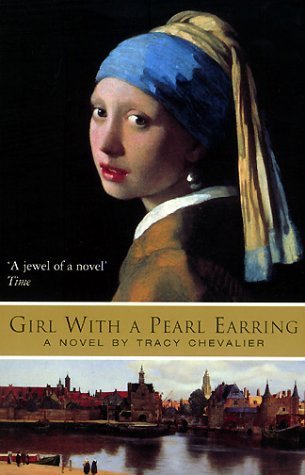
Review: Girl With A Pearl Earring by Tracy Chevalier

Griet, the young daughter of a tilemaker in seventeeth century Holland, obtains her first job, as a servant in Vermeer's household. Tracy Chevalier shows us, through Griet's eyes, the complicated family, the society of the small town of Delft, and life with an obsessive genius. Griet loves being drawn into his artistic life, and leaving her former drudgery, but the cost to her own survival may be high.

When Tracy Chevalier was a guest on BBC World Book Club she said that the longer she looked at the eponymous painting the more she wondered about the relationship between the subject and the artist, and what made the girl look so yearning and fearful at the same time. This book is an exploration of these questions and answers, and it packs a surprisingly hefty punch for such a slim novel. The surprise is of course a result of the 600+ page tomes we are so used to nowadays, and is a reminder that a book doesn't have to be heavy enough to pass for a weapon or a small boat anchor to hold a world vivid enough to make a reader want to explore it further and characters so complex and full of personality that they stay with you long after the book is finished.
In a lot of ways this novel is like a painting, with symmetry between various characters' relationships, juxtapositions of actions and traits, and repeating details that tie the story together. Just like in the painting Griet is at the center of the novel, with her small world reflected in the pearl earring she must wear to complete the work of art. She is an unusual teenager, by current standards, with her sober appraisal of people and situations, clever navigation of the Vermeer household and her being almost completely distanced from her own emotions and relying on reason more than feelings in her decision-making. Had it not been for their respective circumstances I think she would have made a good partner for Vermeer, despite their age difference, for while devoted to his art she does see the world outside of it. She would balance him out in a way that nobody in his family does.
There is quite a bit of allegory and symbolism in this novel, which also reminded me of works of art. While in New York last week I visited The Cloisters museum and the guide there explained every detail of a statue as a symbol of something relating to the patron to whom the statue belonged. I got a similar impression reading this book that a lot of what happened or existed in the story had a special meaning. Sometimes the allegory is subtle, sometimes it's obvious, but it works nonetheless.
There are as many conflicts in this novel as there are symbols and the main one, the one that drives the story, is rooted in Griet's internal struggle between a good protestant girl who takes pride in clean floors and starched caps and a passionate girl in love with colors and beauty. I think this is the discord Vermeer captured so well in his painting and I commend Chevalier for writing it so believably.
The language of the book and Griet's voice work very well with the subject and plot of the novel. There is restraint and spare prose which are easy to associate with protestant sensibilities, and there are also glimmers of the more liberal aesthetic that runs as an undercurrent in Griet's personality, hidden from everyone, just like her hair, but showing through in her eyes and actions.
I never really understood why Griet's role as assistant to and later model for Vermeer was to be kept secret from his wife. It is true that there was animosity, and the situation could be seen as different despite the fact that this was not the first time Catharina lent her clothes or her jewels for her husband's paintings, but had everybody not acted in an unusual fashion and had they been upfront with Catharina the drama could have been avoided. This novel wouldn't be what it is though either, so I suppose the drama was necessary.
I've been thinking about this book since I finished it, mulling over Griet's decisions throughout the novel, Vermeer's single-minded focus on his work at the expense of everything else, Maria Thin's place in it all and Griet's parents' contribution to the story. I wonder how close Chevalier's interpretation is to what really happened between the Vermeers and the girl with a pearl earring and whether had even one character been different the novel would have been as engaging as it is. The paperback copy of the book I read was on loan from a friend, so I will be purchasing a copy for my home library, because for me this one is a keeper.

Sunday, August 26, 2012

Review: The Birth of Venus by Sarah Dunant

The Birth of VenusAlessandra Cecchi is not quite fifteen when her father, a prosperous cloth merchant, brings a young painter back from northern Europe to decorate the chapel walls in the family’s Florentine palazzo. A child of the Renaissance, with a precocious mind and a talent for drawing, Alessandra is intoxicated by the painter’s abilities. But their burgeoning relationship is interrupted when Alessandra’s parents arrange her marriage to a wealthy, much older man. Meanwhile, Florence is changing, increasingly subject to the growing suppression imposed by the fundamentalist monk Savonarola, who is seizing religious and political control. Alessandra and her native city are caught between the Medici state, with its love of luxury, learning, and dazzling art, and the hellfire preaching and increasing violence of Savonarola’s reactionary followers.

A colleague gave me this book saying that I was going to love it and she was right. From the very first pages it was obvious that this was not your ordinary historical fiction, it really couldn't be with a nun having a tattoo of a serpent on her torso, and I looked forward to finding out how that came about.
Freedom, independent thought and pursuit of learning are prominent themes in this novel and it was interesting to see them explored in the context of Renaissance Florence. I'd always assumed that with Florence being the cradle of art and learning of that time it was a relatively progressive society where curiosity and education were encouraged for anybody who had the means to pursue it, but this novel paints a picture of a society where women were not encouraged to pursue much beyond getting married and birthing children, and a passion for learning was considered a shameful shortcoming, one to be kept a secret, a sin even. That was very surprising to me, considering how different was the world of Milan in the same period as portrayed in Leonardo's Swans by Karen Essex, with Isabella d'Este openly patronizing artists and collecting art. I could hardly believe both books were set in the same era and in what we now know as the same country.
The story was full of unexpected plot twists, from the problems with Alessandra's marriage to her relationship with the painter, whose name we never find out. They kept the story moving but for me they weren't the most interesting part. Instead I preferred Alessandra's passion for art and literature, her willingness to take risks to pursue painting, and the effect that practicing her art has on her. I particularly enjoyed the section where she painted her way through the darkest depression saying that that was how she healed herself. Moreover, it was fascinating to see such literary erudition in a person so young. I am twice Alessandra's age and I haven't read the Divine Comedy even once, let alone Aristotle or Socrates. Having read a number of novels set in centuries past I'm inclined to believe that this was not unusual for nobility of that time, and every time I read about characters like Alessandra I can't help but be impressed.
What I had trouble with was character development. Majority of secondary characters were one-dimensional and sometimes even the key traits of main characters weren't all that prominent until they were stated. For example, there is much talk about Alessandra wanting to be free from the constant supervision she had in her parents' house, but I never got that vibe from her until it was expressed for the first time. It actually took me by surprise, I thought she seemed quite content, her antagonistic relationship with her brothers notwithstanding. My favorite characters in this book were Alessandra's mother, her slave Erila, and her husband Cristoforo. They had histories, secrets, and there was an energy about them that made me want to learn more about them. They were also the ones who allowed the humanity of Alessandra's character to be revealed to a greater extent, improving the novel in the process.
The story unfolds against the backdrop of a religious zealot taking hold of Florence with his teachings and the effects this has on the city. This situation and how it changes Alessandra's life and prospects is an interesting commentary on what can happen in a society if a charismatic leader wins over increasingly greater crowds and how the social landscape can change as a result.
This is an intriguing story driven by characters with plenty of secrets and I would recommend it to anyone who enjoys historical fiction with a twist.

Sunday, June 24, 2012

Review: Trade Winds to Meluhha by Vasant Davé

Trade Winds To MeluhhaIn ancient Mesopotamia Samasin the stable boy is falsely convincted of murder. When a double eclipse saves his life he flees his homeland in search of a man whose name the dying victim whispered to him. With murderers eager to protect their crime network on his heels Samasin faces an adventure of his life.

I grew up on adventure stories that spanned continents, with Jules Vernes' In Search of the Castaways and the Mysterious Island being my favorite, and Trade Winds to Meluhha certainly reminded me of the hours I spent imagining distant lands with danger at every step. Mr. Davé did a great job crafting an elaborate story that was not at all straight-forward and although towards the middle all the culprits were perfectly clear the many obstacles in the way of bringing them to justice kept things interesting. There were several sub-plots and adventurous asides that in the end played a role in the main story and I commend Mr. Davé for crafting a novel with this many levels and still managing to keep the pace up without a sluggish moment to create a satisfying resolution that felt natural and logical.
With this many plot lines to keep track of the abundance of characters was taxing at times. Two I had trouble distinguishing altogether, some I wasn't sure were all that necessary, but the main characters were intersting and developed nicely, so I mostly paid attention to them. I liked how they ofthen had secrets that kept me guessing for a while and I enjoyed seeing their transformations as the novel progressed. I think Velli was probably the most changed character by the end of the book and it was fun to see her gradual evolution from a hauty daughter of a wealthy man to a kind and caring lady.
My main issue with this book was the language. It wasn't awkward or inappropriate at any time, but it felt foreign, like a translation that is done without allowing for stylistic differences between two languages. It wasn't a deal-breaker by any means but it did affect my perception. Another factor was that the novel is set in ancient time, two thousand years BC, but a lot of the speech patterns, terminology and idioms used in the book are modern. Combine that with a drug trade and human trafficking and often the novel felt like present day crime drama somehow transported into the time of camels and reed ships. Also, I felt that the whole human trafficking situation was a bit contrived. Had the author stuck with slavery the key developments could have been easily preserved without compromising anything but the story would have felt more time-apropriate and natural.
In the end this is a solid adventure novel with great characters and it made me want to read more in the genre.

Sunday, June 10, 2012

Review: The Reader by Bernhard Schlink

The ReaderAs a 15-year-old boy in postwar Germany, Michael Berg had a passionate affair with a mysterious, guarded woman twice his age that ended suddenly when she disappeared. Years later, Michael sees her again -- when she is on trial for a terrible crime.

The original plan for this week was to read and review Wolf Totem by Jiang Rong but after a week of struggling through the first 30 pages I had to face the fact that for all the acclaim the book garnered Mongolian sheep herders were not going to hold my interest. The morning I decided it was time to move on a friend left a copy of The Reader on my desk at work and I dove in on my lunch break.
At first glance The Reader tells the story of a 15-year-old boy who has an affair with a woman in her thirties and how it affects him for the rest of his life. That is only the outer layer of the story though: as soon as you look deeper you see that more than anything it is about Germany after WW2, about shame and guilt, right and wrong, struggling with finding an identity for a generation that is coming to terms with the past and picking up the pieces. And it's not just my or some critic's opinion, Mr. Schlink tells us as much himself when Michael ponders his generation and its heritage, and tries to understand the past. Another reason that leads me to believe that this book is less about the relationship of Michael and Hanna and more about the German society after the war is that at no time does Michael ask in the book how could Hanna do what she did to him but there's plenty of times when he talks about how could the Germans allow the atrocities to happen, how could they not stand up to it all, how could they accept the former fascists back into society. It is as if he is more scarred by that than by having his whole life ruined by and eventually, in a way, devoted to a woman who didn't seem to care about the consequences of her actions.
One of the strongest features of this book is its elegantly spare, declarative prose. There are few explanations, just simple statements of facts that are offered to us without reservation. There are reflections on morality, humanity, right and wrong, and they too are so simple that they give the novel depth without rendering it unreadable. Yet as positively unflowery as the writing is the author manages to tell us exactly who his characters are, allows us to discover them gradually and without inflicting his own conclusions upon us, creates perfectly complete portraits with a few well-chosen words and well-placed sencentes.
There is a lot of story in a book that is barely two hundred pages long and since we only get Michael's side of it by no means does Mr. Schlink tell us all there is to tell. There is plenty to think about and I hope that if you haven't read this book that you will add it to your to-read list. It is most definitely worth a day or a weekend of your time.

Sunday, April 8, 2012

Review: The Book Thief by Markus Zusak

The Book ThiefIt’s just a small story really, about among other things: a girl, some words, an accordionist, some fanatical Germans, a Jewish fist-fighter, and quite a lot of thievery. Set during World War II in Germany this is the story of Liesel Meminger, a foster girl living outside of Munich. Liesel scratches out a meager existence for herself by stealing when she encounters something she can’t resist–books. With the help of her accordion-playing foster father, she learns to read and shares her stolen books with her neighbors during bombing raids as well as with the Jewish man hidden in her basement before he is marched to Dachau.

I wasn't planning on reading this book this year despite its reputation as a very good novel and all the positive reviews. WW2 and its horrors seemed just too close, too terrible to read about when my grandmother, who was a girl of about Liesel's age when it tore through her childhood, still sometimes talks about it. However a friend invited me to her book club and The Book Thief was next up so I picked it up from the library. The first few chapters were a bit difficult to get through (Zusak's writing style is somewhat unusual) but the more I read the more I understood what all the fuss is about. Very soon I felt invested in Liesel's story and wanted to know more about her and the other characters. They've gradually come alive and I found a certain sensitivity and wisdom in the way the author was depicting them and telling the story. I particularly liked Rosa, Liesel's foster mother. She was the one who surprised me on more than one occasion with all the layers to her personality and I applaud the author for creating her just the way she is.
The more I think about this book the more I appreciate its prose where a few spare words hold more meaning than whole paragraphs elsewhere and descriptions are so strange that they make perfect sense and stay with you for days ("frightened pajamas and torn faces" did).
Having Death as the narrator allowed for both the more intimate first person storytelling combined with the omniscient third person point of view that is much less limiting and I feel that this combination served the novel very well. It was startling sometimes how human Death seems, with his fatigue, regret, sarcasm, insights into humanity and the occasional bitterness over the things he's seen. Another device I have grown to enjoy were the regular interruptions to provide explanations, translations (much needed with a book so full of German words), and other such asides, it kept things moving and was a little bit of a distraction in an otherwise very serious novel.
The subject of WW2 isn't an easy one, despite being widely covered. Lives were destroyed, whole countries were devastated and something like that isn't easy to get over. There's a lot of books and TV and radio programs that talk about the genocide, about Hitler and his party, but I haven't seen or heard any that would talk about the regular German citizens who were in the middle of it all, their allegiances, their problems, their relationships with the people in their communities who found themselves ostracized for their heritage. Admittedly, I didn't look, but this book was my first window into the lives of ordinary families who lived during those tumultuous years and had to choose which side they were on. The more I read the more the realization that Nazi Germany and Socialist USSR were very similar despite all their differences. The propaganda, the need to be a member of the Party to be able to lead a life that wasn't artificially complicated for you, the poverty and the division of society were present on both sides of the divide, and as much as the leaders of both countries preached from their podiums that the others were evil incarnate now I think that they were just different sides of the same coin. I'm glad that I read this book, for this if for nothing else.

P.S. There is now a beautiful movie out that's based on this wonderful book, I haven't seen it yet, but judging by the trailer the film-makers have stayed close to the story

Monday, February 27, 2012

Review: By Fire By Water by Mitchell James Kaplan

By Fire, By WaterLuis de Santangel is the Chancellor to King Fernando and Queen Ysabel of Castille and Aragon but even his position will not keep him safe from the clutches of the New Inquisition and their quest to seek out and destroy those with Jewish heritage. Judith Migdal is an unmarried woman taking care of an elderly relative and her young nephew. After her sister and her husband die she must learn to become a silversmith to support her family in the Jewish quarter of Granada. Cristobal Colon's greatest dream is to reach India and Jerusalem by sea and he will dedicate his life to accomplishing it. History brought these people together and they will change each other's lives forever.

I am absolutely delighted to tell you about this book because this is one of those rare reads where everything is just right. A while back the author contacted me asking for a review of his debut novel and having never read anything set in Spain of that era I decided to give it a try. Reading it last week I congratulated myself on this decision more than once. This is an intelligent, well-written novel that combines drama, history, politics and, to a lesser degree, romance.
I really enjoyed the characters of the honorable Luis de Santangel, the resilient Judith, and the supporting cast who all played a role in the events. Sometimes it would seem that a completely new character was introduced for no observable reason but then time would pass and this seemingly-insignificant character's contribution would become obvious, be it to further the plot, make the setting more vivid, or aid in the development of the main characters. No character arc was left incomplete and seeing them all develop was deeply satisfying.
This isn't really a straightforward set the goal - overcome difficulties - achieve the goal type of novel. Cristobal Colon's endeavor to obtain the monarchs' support in sailing to India is a secondary plot. It is the life of Luis de Santangel and his struggle with his heritage at a time when practicing anything other than Christianity was a sure way to the stake is at the foreground of this story. The life of Judith and her family provides an excellent contrast by giving us a glimpse of a life the Jewish community had in Muslim Granada.
Mr. Kaplan spent six years doing research for this book and the work he's done brings a lot of credibility to the novel. The details shine through on every page and fortunately he didn't let history and theological debate overpower the story, at the end of the day it was still about Luis, Judith and their loved ones.
Usually at this point I talk about things that didn't work for me. Today there isn't anything for me to say. Go get this book. Read it. Enjoy it. This is a quality novel that is worth reading regardless of whether you're a fan of historical fiction or not.

Sunday, February 12, 2012

Review: The Shadow of the Wind by Carlos Ruiz Zafon

The Shadow of the WindBarcelona, 1945 - Just after the war a boy named Daniel awakes one day to find that he can no longer remember his mother’s face. To console his only child Daniel’s widowed father initiates him into the secret of the Cemetery of Forgotten Books, a library tended by Barcelona’s guild of rare-book dealers as a repository for books forgotten by the world, waiting for someone who will care about them again. Daniel so loves the book he selects, a novel called The Shadow of the Wind by one Julián Carax, that he sets out to find the rest of Carax’s work. To his shock, he discovers that someone has been systematically destroying every copy of every book this author has written. In fact, he may have the last of Carax’s books in existence. Before Daniel knows it, his seemingly innocent quest has opened a door into one of Barcelona’s darkest secrets, an epic story of murder, madness, and doomed love. Before long he realizes that his search for the truth about Julián Carax will bring great suffering to him and those closest to him but there is no turning back.

The first time I heard about The Shadow of the Wind was on BBC World Book Club and it intrigued me immediately. The idea of a book stirring up such trouble and a terrible mystery in the middle of it proved irresistible so imagine my surprise when I discovered the book already waiting its turn on my bookshelf. Not sure when I got it, or where, but I was glad to see it there nonetheless.
The story gripped me from the very first pages, which was easy to do with evocative writing and characters depicted so well that they seemed to be real people trapped in the pages of the novel. They were far from perfect, riddled with weaknesses in fact, but that only made their strengths stand out that much more. The same goes for the setting - the world Zafon created, or portrayed, isn't pretty. There is pain and horror at every turn, some of the things that happened made me wonder why hasn't anyone stopped the perpetrators, why the terrible things were allowed to continue. But that's life, I suppose, and I applaud the author for giving them a place in this story and in this way providing a contrast for the decency and kindness.
There are parts of the book that might create an impression that supernatural forces are at play but I was pleased to discover that all events had a very reasonable explanation and were firmly grounded in facts and people's actions. If they weren't it really would've been too much - in Zafon's post-war Barcelona even things that had a perfectly reasonable explanation seemed fantastical at times.
My favorite thing about this novel was how everything and everyone seemed to be connected, down to the most seemingly insignificant detail. All the threads of the tangled knot that is the mystery of Julián Carax and his life eventually were revealed to be part of one whole and discovering the connections was simply exhilarating. The runner-up favorite thing was seeing the parallels and similarities between Daniel and Julián and their lives. It really seemed as though Daniel was always meant to be the one to find out the truth and everything and everyone simply waited for him to be ready to do it.
I enjoyed this novel from the first till the last page and even the few inconsistencies that seemed to jump out at me didn't spoil it. It was easy to see that some things were done for dramatic effect, and one element of the mystery was obvious to me since I've seen quite a bit of it in Latin American telenovelas, but all that was generously compensated for when the identity of the person who was destroying Carax's books was revealed. If it was anyone else I probably would've felt cheated so I'll forgive the author the little shortcomings and will recommend this novel to anyone who enjoys a good mystery, great writing, unique characters and above all a book that's difficult to put down.

Sunday, January 29, 2012

Review: The Historian by Elizabeth Kostova

The HistorianThe Historian is the story of a young woman plunged into a labyrinth where the secrets of her family's past connect to an inconceivable evil: the dark fifteenth-century reign of Vlad the Impaler and a time-defying pact that may have kept his awful work alive through the ages. The search for the truth becomes an adventure of monumental proportions, taking us from monasteries and dusty libraries to the capitals of Eastern Europe and back to modern-day America where it all began.

When I first picked up this book I thought it was good old historical fiction (don't judge the book by its title as well as its cover, I guess. And no, I didn't read the blurbs on the jacket, the hype was enough to intrigue me). Imagine my surprise when I realized that vampire lore was such a large part of the story! Not just any vampire lore either, the good old traditional lore, steeped in the superstitious culture of Eastern Europe, with frequent references to Bram Stoker's Dracula. I dived right in and while things seemed to start out a bit slow soon I couldn't put the book down. Let me tell you, this isn't flat-out a vampire book. It's more of a historical adventure novel with a search for a missing scholar in the center of it, and just so happens that Dracula himself is the main suspect.
Elizabeth Kostova has done a tremendous amount of research for this book and while more often than not I really enjoyed all the historical background sometimes it got to be too much. There's just so much scholarly-ness a casual reader can take! Fortunately that is my biggest gripe, the rest of it worked: the fact that majority of the novel is told through letters, the characters, the suspence, the detective work the scholars have to undertake, the gradual reveal of the past and the gradual build-up of danger. Kostova really knows how to set the scene and create a sense of the place. When I read about the events set in Eastern Europe I felt that she got it so right, the blend between modern and archaic, the old beliefs that permeate everything, the rich culture stained and whittled away by the Communist efforts to mold everything into their special brand of uniformity.
The chapters where fantasy took center stage seemed almost too surreal after all that historical detail. It all made sense and the horror of the situation was always understated in that old-fashioned manner of Stoker's Dracula but somehow I just didn't expect it to happen quite the way it did. What redeemed this part of the story is the ending. I really enjoyed the way Kostova wrapped things up, although I can see how some readers might dislike it for this exact reason.
I would recommend this book to fans of historical fiction, adventure and fantasy and if you don't mind a hefty tome that's just as well because this one is huge!

Sunday, November 6, 2011

Review: All The Queen's Players by Jane Feather

All the Queen's PlayersWhen she becomes a junior lady of Queen Elizabeth’s bedchamber, Rosamund is instructed by her cousin, the brilliant and devious secretary of state Sir Francis Walsingham, to record everything she observes. Her promised reward: a chance at a good marriage. But through her brother Thomas, Rosamund finds herself drawn to the forbidden, rough-and-tumble world of theatre, and to Thomas’s friend, the dramatic, impetuous playwright Christopher Marlowe. And then Rosamund meets Will Creighton—a persuasive courtier, poet, and would-be playwright who is the embodiment of an unsuitable match. The unsanctioned relationship between Rosamund and Will draws the wrath of Elizabeth, who prides herself on being the Virgin Queen. Rosamund is sent in disgrace to a remote castle that holds Elizabeth’s cousin Mary Stuart, the imprisoned Queen of Scots. Here, Walsingham expects Rosamund to uncover proof of a plot against Elizabeth.

I must confess, when I read the many lukewarm reviews of this book I prepared myself for the worst. Fortunately I shouldn't have worried, I actually enjoyed this novel even despite the romance-y parts (all the between-the-sheets adventures are not my cup of tea).
One of my favorite things about this novel is that little about it was straightforward. There is a lot of intrigue, both political and personal. Everyone has something they want and the means they employ are hardly ever savory. I've always thought that "life at court", wherever and whenever the court exists, is a dark place and this novel only supports this belief of mine. What would anyone want to be there is beyond me. Excitement? Closeness to the ones with power? Are they really worth the need to constantly watch one's back, literally and figuratively? But I digress. Fortunately all the talk about the intrigues didn't swallow up too much page time and didn't slow down the story as it often does. Another element I enjoyed is tied into the intrigues and has to do with how quickly it all can suck one in. Rosamund, the protagonist, went from an innocent, sheltered girl to one of the key players in a conspiracy at the highest levels in the blink of an eye and with no way out, and she wasn't the only one trapped in the quicksand.
In a simple but effective device the author gave almost every character an antipode, which served to highlight their personalities. Elizabeth had Mary, Will had Arnauld, Mrs. Walsingham had Agathe and interestingly enough Tom had Kit. Kit was the most intriguing of them all, a man with seemingly no moral compass but showing more scrupples and higher standards than any of his associates and at the most unexpected of times. If nothing else he was more true to himself throughout the novel than any of the others, even Rosamund who even in the most dire of circumstances managed to go her own way.
The novel spans less than a year but Rosamund's growth in just several months is incredible. The girl who was most concerned with capturing the apple blossom just right on her parchment grew into a young woman familiar with the price of life and death and the pain of loss and deceipt. In short, she grew up and as traumatic as the journey was it was interesting to follow it.
The whole book is permeated with Rosamund's love for the theater, which in fact is the cause of all her troubles. It was interesting to look in on this world that wasn't considered suitable for the gentle-folk and women in particular, and the appeal it held for people of all layers of society. Nowadays theater isn't all that popular and reading about people being willing to risk their reputation and their future to attend a play is a bit surreal. I can't even imagine what would be comparable in today's world. Makes me glad to be living a simple life in this century and not at court in Elizabethan England - it would seem that even those not involved with the performing arts found themselves acting every day whether they liked it or not.
The parts I didn't enjoy had to do with the particularly descriptive intimate scenes that I felt were gratuitous most of the time and the fact that some ideas kept being repeated, as if the author either forgot that she's already had her characters say things exactly the same way before or wanted to reiterate them but didn't do it very well. In either case, the effect wasn't favorable. Another oddity that caught my eye is that the novel is set in England, the language appears to be true to the period with archaic turns of phrase and sentence structure but the spelling is infallibly American. I'm sure it isn't too much of a stretch to believe that the readers on this side of the Atlantic can figure out that "theatre" is the same as "theater" and "colour" is "color" and it would've kept the atmosphere consistent.
All in all this was an enjoyable read that satisfied my appetite for historical fiction. And I found myself using words I've forgotten I knew, which hasn't happened in a while.

Friday, October 21, 2011

Review: Leonardo's Swans by Karen Essex

Leonardo's SwansEver since they were little girls Isabella and Beatrice d'Este were betrothed to very different men. Isabella's fiance is to take her to the country, to the estate of a family knows for breeding the best horses in Italy and she was to become a marquesa. Beatrice's betrothed is a learned man, the regent to the duke of Milan, a renown patron of the arts, a politician like no other and one day Beatrice may become a duchess of greatest city-state in Italy. It's too bad that Isabella has a brilliant mind and loves to collect beautiful works of art and Beatrice wants nothing more than to spend days on her horse. Their sisterly rivalry turns serious when the girls fall in love and begin to fight for the affection of one man and the opportunity to have a great artist paint their portraits.

My favorite thing about this book is that it exposed me to some very interesting people who lived in 15th century Italy. Without it I may have never heard about the incredible Isabella d'Este, may have never looked up the paintings mentioned in this book, may have never thought about Leonardo da Vinci as a man outside of his work.
Ms. Essex did a great job of getting into the women's heads and showing us what they thought and felt at the most important times of their lives. I preferred Isabella not because her character was easier to relate to but because her sections were deeper, more intimate and showed what the ways of the Italian nobility were at the time. She was a woman of great intellect, an art connoisseur, a formidable opponent for any man in the political arena as well as a woman of great beauty, grace and charm. It was fascinating to learn about her and I intend to read more about her in the future.
Leonardo da Vinci is a prominent character in this book but we never get to hear about the events from him. He is always talked about by either Esabella or Beatrice and while their descriptions paint an interesting portrait (no pun intended) it would've been very interesting to get his take on the events of the time and the people with whom he was in such close contact. Throughout the book there are excerpts from Leonardo's notes that are both his reflections about the subjects of his studies and to-do lists that give us a glimpse into the mundane part of his life. These excerpts are not invention of the author, they are actually taken from da Vinci's notebooks and effectively bring the reader closer to the time and the characters of the book.
As impressed as I was by the characters this novel fell a bit flat for me because of the writing. The narrative went from lively scenes that were very engaging to sections that read more like a chronicle and back. Because of this the story didn't hold my interest as much as it could have and I had no trouble setting it down and sometimes even found myself zoning out during the accounts of who invaded whom and who was suspected of whose death. The fact that the narrative often changed between past and present tense from one paragraph to the next didn't help eather and even though eventually I managed to ignore the back and forth between the "is" and the "was" the challenge of having to do it detracted from the enjoyment of the book.
I would recommend this novel to those readers who are interested in learning about Italy at that tumultuous time in history, enjoy fascinating characters and feel they'll be able to ignore the inconsistencies in tense and less than stellar bridges between the scenes that actually had some life to them.

Friday, October 7, 2011

Review: Water for Elephants by Sara Gruen

Water for ElephantsThough he may not speak of them, the memories still dwell inside Jacob Jankowski's ninety-something-year-old mind. Memories of himself as a young man, tossed by fate onto a rickety train that was home to the Benzini Brothers Most Spectacular Show on Earth. Memories of a world filled with freaks and clowns, with wonder and pain and anger and passion; a world with its own narrow, irrational rules, its own way of life, and its own way of death. The world of the circus: to Jacob it was both salvation and a living hell and in the end it was a life he never expected.

I looked forward to reading this book ever since the movie based on it was announced but by the time I finally got my hands on the paperback the much-anticipated film was so close to release that I decided to wait to read the book until after the movie has faded from my memory. And so it is only now that I've read it, staying up late to enjoy Sara Gruen's beautiful prose and to be impressed by the diverse cast of the book's characters. Getting to know Jacob, Marlena, Rosemary, Walter, Camel and even August and Uncle Al was an absolute delight, especially since they continued developing until the very end, revealing new facets of their personalities and details about their past that made them who they are.
The narrative alternates between the past, set in 1930s, and the present, which could really be now or 10 years ago, we don't get much information as to what decade it is. In the present the 90, or 93-year-old Jacob is at a nursing home, struggling with his age and helplessness and remembering the beginning of his life at the circus and the beginning of his love affair with Marlena, the beautiful and talented performer in the liberty horse act. In the past he is 23, living the most exciting and the most perilous months of his life. Sometimes the back and forth such as this can be confusing, detracting from the experience, but in this particular case it was executed so well that seeing the past and the present helped create a fuller picture. It's so much easier to understand old Jacob and his frustrations when you know what he's lived through, and watching the events of the early 1930s unfold you always have a sense that it's not just a story, it's the turning point in a life, several lives in fact.
Although Jacob's relationship with Marlena is central to the story and is a catalyst for pretty much everything that happens my favorite relationships are the ones he has with Rosemary and Walter. They may not be as emotionally charged, but there is a depth and a poignancy to them that I didn't see in his relationship with Marlena. Similarly, I was a bit surprised when he talked about being almost in love with the elephant, feeling protective of her and not being able to let her go when the time came. Throughout the book I didn't see much distinction in his connection with Rosie and the rest of the animals in the menagerie apart from the fact that she was the newest and most expensive member of the team and a lot of attention was paid to her. If I had to choose one animal with whom I could see he had a bond it would be Bobo the ape. There was the tenderness and the affection that wasn't present in the scenes with Rosie, that's where I could see a friendship being born. With the two main relationships feeling under-developed I couldn't help but think that Ms. Gruen did a wonderful job with the secondary cast but could've devoted more attention to the main players.
As much as I enjoyed the novel the very end of it seemed like a bit of a stretch to me. Up until then I believed everything that happened. It seemed logical and completely plausible with even the most outrageous turns of events seeming unexpected and amazing at the most. This is circus after all, anything can happen there. But when it came to the final chapters I just couldn't shake the feeling that I didn't believe it, it was just too good to be true. I can't tell you more but once you read the book, or if you've already read it, I'd love to hear what you thought.
This really is a very good novel and I'll wholeheartedly recommend it to anyone. After all, may be I'm just becoming picky :)

Friday, September 23, 2011

Review: Heretic Queen by Michelle Moran

The Heretic QueenNefertari has a shadow hanging over her wherever she goes - she is the niece of the hated heretic Nefertiti, the spare princess allowed to live in the palace but mistrusted by almost everybody. If she wants to marry the love of her life, Ramesses, become queen and ensure her family is eternally remembered she must make the people of Egypt embrace her for who she is and forgive her family's past. But will Nefertari's enemies let that happen?

Beginning Moran's second novel I wondered if she would be able to repeat the magic of Nefertiti and give us a different book at the same time. I hoped she would and fortunately she did. Reading the first chapter of this book is like stepping through a gateway between time and place and ending up in ancient Egypt, not a foreigner to whom everything is explained but an observer who doesn't require any special treatment. This is one of the reasons I like Moran's books - there's no explaining. She knows that the readers will make intuitive leaps, they'll understand things from context and there's no need to document every breath.
Nefertati is a very interesting character in that her struggle for a place in the royal dynasty happens when she's not even 17 years old but she is no longer a child. She is intelligent, honest, hard-working, loyal and admirably courageous. She makes difficult decisions and she doesn't complain when things are hard. It would be so easy for her to become bitter and angry when everybody seems to be against her, when her enemies are too strong and dangerous and when the people won't accept her but she retains her kindness and compassion and keeps going, becoming only more determined as she moves towards her goals.
The secondary characters are very interesting as well and I grew fond of Nefertari's friends and teachers. They are kind but don't let things go to her head and they complement her very nicely. One might argue that the characters are too one-dimensional in their being either good or evil but somehow they never feel that way. There's always humanity in Iset, Rahotep and even Henuttawi while Merit, Paser and Woserit have their own demons to fight. You just know that things aren't all that simple.
I really enjoyed watching the relationship between Nefertari and Ramesses unfold. They started out as friends, then fell in love and married and theirs was a true partnership of two like minds working to achieve the same goals. Things weren't easy for them but they were in it together and reading about them was so pleasant, especially when outside of their chambers the court was so full of intrigue and deceit. The court intrigues are really the only thing that soured the experience for me (I don't like the politics that come with life at the very top) but without it all the story wouldn't have been realistic so I suppose we couldn't have done without them.
One of my favorite messages in this book is that intelligence is more valuable than the most dazzling good looks. As Nefertari said "Her beauty might fascinate men, but it was difficult to charm them when she stood mute..." I think that in today's culture that's all about beauty and youth we often forget that a pretty face isn't everything.
If you like a well-written historical novel that's told in a clear, simple and warm voice and is never dull I think you'll enjoy this book.