Showing posts with label Thought-provoking. Show all posts

Sunday, May 19, 2013

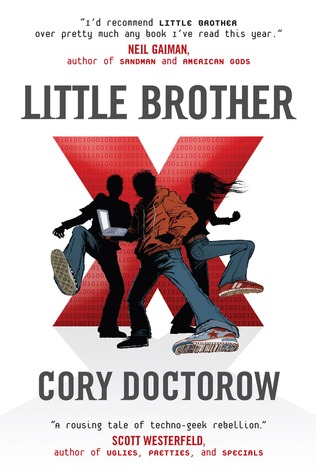
Review: Little Brother by Cory Doctorow

Marcus aka “w1n5t0n,” is only seventeen years old, but he already knows how the system works – and how to work the system. Smart, fast, and wise to the ways of the networked world, he has no trouble outwitting his high school’s intrusive but clumsy surveillance systems.
But his whole world changes when he and his friends find themselves caught in the aftermath of a major terrorist attack on San Francisco. In the wrong place at the wrong time, Marcus and his crew are apprehended by the Department of Homeland Security and whisked away to a secret prison where they’re mercilessly interrogated for days.
When the DHS finally releases them, his injured best friend Darryl does not come out. The city has become a police state where every citizen is treated like a potential terrorist. He knows that no one will believe his story, which leaves him only one option: "M1k3y" will expose the DHS himself.

We all know someone who insists on paying for everything in cash, or who won't bank online, or who is absolutely convinced that big brother is out to get them and everybody else, or at least that big brother is watching. We listen to them and think to ourselves "That's just crazy talk. Can you say Paranoia?". But what if they're right? What if those security cameras are more than just ordinary anti-theft precautions? What if our spending histories are tracked by some entity other than our banks? What if all the electronic devices we've come to rely on so much can be and are monitored to establish our movement patterns and what not? It's not really paranoia if what you're concerned about is really going on. Cory Doctorow examines a world like that, a world where everything is bugged. School books have chips in them, gait recognition cameras are everywhere, credit cards and public transit passes are used to track movement of their holders, and all this feeds into whatever agency is in charge, be that the school board or the Department of Homeland Security. After a terrorist attack the system is thrown into overdrive and Marcus is one of the first victims of the indiscriminate checks performed by the overzealous officials, who seem to be looking for someone, anyone to pin the crime on. At only 17 he's scared but he's not backing down, instead he's fighting the system with its own weapons.
My favorite thing about Marcus is that he is a realistic character in that he is not some superhero devoid of fear, and when he is afraid he is not too proud to admit it. At the end of the day he is just a kid against adults who have all the power, he fights when he can and with the tools he has but he isn't reckless about it because he knows that more than just his freedom is on the line. And when things go as far as they can with the status quo unchanged he recognizes that it's time to take the fight to the next level, time to hand it off to those with more resources and more influence. He is also a 17 year old with a life outside of the fight. He has a girlfriend, he is at odds with his dad, he reads books and does school work, he plays video games and mouths off to his teacher.
Marcus' father is a character who represents the "I'm not doing anything wrong so I don't see what the big deal is, let them check and monitor and catch the bad guys" side of the argument, and I'm glad that Doctorow wrote him this way. I'm also glad that this wasn't his position from the very beginning of the book, it showed that people can and will change their minds under certain circumstances. It also showed that such changes of heart are not seamless or painless.
Marcus' friends and acquaintances cover the remainder of the spectrum, from spirited support of his actions to adamant disapproval. There are also those who are spies out of necessity, recruited by the DHS to infiltrate the underground network. The tensions resulting from these interactions provided the difficulties that made the story more believable, after all life's not all black and white, the gray often dominates the playing field and that's just how it is.
Overall I loved this novel, but what made it a little less enjoyable for me is all the technical talk. Marcus often walks the reader through what the different bugs and gadgets are, how they work, how they can be deactivated or circumvented, and since I'm the kind of person who loves her gadgets but doesn't particularly itch to find out how the software and hardware work it went over my head on occasion. Besides, I figured it was all author's imagination steeped in today's technological reality. But then at the end of the book one of the afterwords is by a security technologist, whose job is basically to figure out how electronic systems can be broken and how to make them more secure, and the other is by a professional hacker. Imagine my surprise and general feeling of unease when these real-life guys started talking about how Doctorow's "inventions" either do exist or aren't that far-fetched. There is also a bibliography with an extensive list of eye-opening titles. I admit, after reading these sections I started to wonder whether I should move my family to a cash-only basis for daily transactions to protect us from the possibility of both big and little brother infiltration (let's face it, if the government has no interest in us there's probably a marcus hacking away within a 2-mile radius from our house). In the end laziness won over that sentiment, but the seed has been sown.
This is a very well-rounded novel that is fast-paced and written in a voice that is casual without being too adult or too adolescent. It poses interesting questions and explores a variety of standpoints that are just as relevant today as they were when the book was published, if not more so. I recommend it without reservation, especially if you are the kind of reader who loves their gadgets, wants to know how they work inside, and wants their privacy to remain their own, regardless of whether there's anything to hide besides grandma's secret pie recipe.

P.S. Those with ereaders, heads up: Doctorow makes the novel available on his website free of charge in a variety of formats under the Creative Common License. Yes, he is that cool.

Sunday, April 28, 2013

Review: The Left Hand of Darkness by Ursula Le Guin

Genli Ai is a lone human emissary to Winter, an alien world whose inhabitants can choose - and change - their gender. His goal is to facilitate Winter's inclusion in a growing intergalactic civilization, but to do so he must bridge the gulf between his own views and those of the completely dissimilar culture that he encounters.

I first read this book in 2011 and already then I knew that I would read it again. The timing of me re-reading it wasn't entirely my choice but in the end that didn't matter at all. Because I knew what was going to happen it was as if my brain was free to notice things I didn't notice 2 years ago - the poetry of the language, the beautifully crafted story, the meaning of the folklore and excerpts of historical records inserted between chapters, the echoes of the philosophy of ying and yang throughout the book, the notion of true gender equality and its consequences. I noticed how perfectly the ending of the novel mirrored its beginning, recognizing the similarities between a keystone being placed in an arch to connect the separate sides and Therem Estraven being a similar kind of keystone that would link two separate branches of humanity. I finally fully understood the title of the book, which made me feel that I understood nothing the first time around. I realized that this novel isn't really about Genli Ai, even though he is the narrator most of the time. It is about Estraven, his vision for Gethen, and about following a path which others can't even see.
Like many other science fiction novels this book isn't about the planet or the technology, but rather about people, human nature and everything that comes with it, such as patriotism, love, deceit, faith and Truth. Yes, it's a lot to talk about in a book that is not at all hefty, but that is where Le Guin's brilliance lies. She doesn't need 600 or more pages to ask questions, ponder answers, observe and make the reader think. Half of that does very well.
I'll keep this review short because what I really want to tell you is that this is an amazing book, that I'm buying it for my collection and that if you haven't read it yet you should, even if you're not a fan of science fiction.

Sunday, September 30, 2012

Review: A Lesson Before Dying by Ernest J. Gaines

A Lesson Before Dying is set in a small Cajun community in the late 1940s. Jefferson, a young black man, is an unwitting party to a liquor store shoot out in which three men are killed; the only survivor, he is convicted of murder and sentenced to death. Grant Wiggins, who left his hometown for the university, has returned to the plantation school to teach. As he struggles with his decision whether to stay or escape to another state, his aunt and Jefferson's godmother persuade him to visit Jefferson in his cell and impart his learning and his pride to Jefferson before his death.

I had a difficult time reading this book, not because of the writing, or the voice, or the characters. All those worked, and worked very well, and that is in part why I won't focus on them this time. What made it difficult is the story itself. At first glance there was nothing I could relate to: a male protagonist coaching a death row inmate, Louisiana plantation in 1940s, persistent, and sometimes surprising, racial divides, poverty, level of education so low you could determine it from speech alone. All this was so far from whe world where I grew up in Eastern Europe and so far from my life now that at times it was challenging to stay conected to the story. Then I would read about Grant's aunt cooking for everybody and loving it when her family and friends enjoyed her food, or about adults making sacrifices to improve their children's lives and give them the opportunity of something better, and I would remember my grandmother and my parents, and that the nature of humanity is the same regardless of time, place, skin color or education, and with this understanding I would be able to regain my grasp on what was happening and keep going.
Another complicating factor was that the main emotions running through the book are anger, bitterness and general dissatisfaction. Grant is unhappy with working as a plantation teacher and being forced into coaching Jefferson. His aunt is unhappy that he doesn't see the bigger picture and even when he does become invested in helping Jefferson he does it in a way with which she disagrees. Vivian, the woman Grant is in love with, is unhappy to not be able to get a divorce from her absentee husband and not have to hide her relationship with Grant. The reverend is upset that he isn't able to get through to Jefferson while a man so much younger, who he belives is a sinner and for all his education still doesn't really understand life, eventually does what he couldn't. And Jefferson himself is bitter and angry about the unfair verdict and the demeaning defense strategy of his attorney, as well as the fact that his young life was going to be cut shortonly because he was at the wrong place at the wrong time and didn't have the werewithal to run. Keeping up with all this negativity was a bit trying for me at times.
We never learn how old Jefferson was, or any of the other characters for that matter, or whether he had a mental handicap, so a lot of his actions and reactions were puzzling to me. I never understood why it took a stranger to make him stop taking out his anger on his godmother, who couldn't be responsible for his predicament by any stretch of the imagination. In fact, there were a few things I didn't understand, such as why Grant essentially punished his students for him being dissatisfied with his life, shortchanging them in the process, or why he professed his love for Vivian and yet asserted himself at her expense, or why Grant's aunt's preferred method of communication was to glare and give silent treatments instead of explaining what her nephew clearly didn't grasp. It may take me a while to understand these thing, maybe I'm simply too young and haven't seen enough of life just yet to do so right now.
This book may have been difficult and not at all uplifting, but it did not leave me indifferent, and it made me think about issues that have never particularly affected me. It made me look at the world around me from a different perspective. It made me wonder about the things the grandparents of people I see around me haven't told them about the past. I may not be able to fully appreciate this novel now, but it certainly has altered the way I look at the world around me and that alone makes it worth reading.