Showing posts with label Fantasy. Show all posts

Tuesday, October 3, 2017

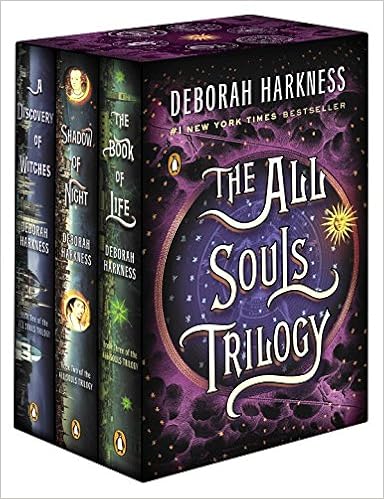
The All Souls Trilogy by Deborah Harkness

"You have to read these books so I would have someone to talk to about them!" a friend gushed in a phone call. "They are so good!"
I hadn't read anything in a while and was eager to get back into the habit, and I'd gotten a few recommendations for this series already, so I decided to give it a go and borrowed A Discovery of Witches from the library.
The story had a slow start, but I liked the promise of the world and the characters so I kept reading. By the time I could tell who was who and where the whole thing was going they'd grown on me, so I dove in deeper, finishing the book in a few days. So much about the story was predictable and formulaic, but because of the close attention the author paid to the characters and the world building I found it extremely satisfying. I loved the intimacy of Diana's routines, her thinking process, her growing fascination with Matthew, the gradual unfolding of and hinting at the mysteries, the lurking danger. The familiarity of the tropes made the story comforting while Harkness' spin on them kept it fresh, so I by the time I turned the last page the sequel was there waiting for me to begin right away.
The first few chapters of Shadow of Night started out as well as one can expect a sequel to do, but soon enough I could tell something was missing. The setting was new and exciting, the challenges our heroes faced were not so familiar any more, there were even a handful of new characters who charmed and amused me, and yet I didn't look forward to reading time as much as I did with the first installment. Soon I realized what it was. The heart wasn't there. I don't know if the story grew and there wasn't enough time or room to develop it properly, or the author was so fascinated with the setting that it overshadowed the story, but I kept thinking to myself "Who are these people and what has she done with Diana and Matthew?!" I could catch glimpses of the characters I'd grown fond of here and there, but those glimpses didn't last long enough. Moreover, as capable as Diana was, I had a lot of trouble believing that she could accomplish that much that well in that short of a time with no practical foundation. I could buy that she was good, but not that she was that good. Had the main mystery been less compelling, I probably would have abandoned the series, but it had me thinking about it and the implications, so I pressed on.
The Book Of Life immediately had the feel of an action-packed blockbuster. There was so much plot that character development seemed barely more than bright flashes in the blur of events, and I had to slow down reading to keep everything straight. It was very exciting though. Extremely. All the connections that tied the story together were coming to light, Matthew turned out to be much more flawed than the prequels revealed (especially the first book), and Diana... Diana went from capable in A Discovery of Witches, to formidable in Shadow of Night, to indomitable in The Book Of Life, a force to be reckoned with in every sense of the phrase. Despite the thrill of the transformation I missed the original Diana sometimes. That one reminded me of a beautiful, soft, pastel-colored rose with sharp thorns. This one was also beautiful, but in a dark, hard way, all sharp angles and razor blades for thorns.
One of my criteria of a great book is whether I would read it again, and this trilogy didn't quite make the cut. I would probably revisit The Book Of Life at some point to get rid of the sensation of whiplash, but I wouldn't buy the trilogy to keep. Had the series been five books, I think it would have been stronger. The story would've had room to breathe, there was definitely enough plot in books 2 and 3 to fill the volumes, and with a concept as rich as this Ms. Harkness could've made it into an amazing series in every respect. As it is, I couldn't quite share in my friend's enthusiasm, despite The All Souls' many positive qualities. I did find my kind of series later though, but that is a review for another time.

Saturday, July 20, 2013

Catching Fire

The Hunger Games trilogy got better with every book and I have high hopes for this movie. Enjoy the trailer!

Sunday, April 14, 2013

Review: The Martian Chronicles - Ray Bradbury

Bradbury's Mars is a place of hope, dreams and metaphor - of crystal pillars and fossil seas - where a fine dust settles on the great, empty cities of a silently destroyed civilization. It is here the invaders have come to despoil and commercialize, to grow and to learn - first a trickle, then a torrent, rushing from a world with no future toward a promise of tomorrow. The Earthman conquers Mars...and then is conquered by it, lulled by dangerous lies of comfort and familiarity, and enchanted by the lingering glamour of an ancient, mysterious native race.

This collection of short stories is considered to be one of the best examples of science fiction, yet Ray Bradbury himself says that it is not science fiction but fantasy. Pretty curious, isn't it? After some deliberation I decided that it is sci-fi after all - in this bibliophile's universe fantasy has magic and while Bradbury's Martians have some nifty abilities they do not have magic. Sorry, Mr. Bradbury, but that's how you wrote them.
The book is organized as a collection of separate episodes from several decades in the future when humans applied themselves to colonizing Mars, and an attentive reader will see clear parallels with the history of the North-American continent in these stories. In some cases they couldn't be any more obvious. Chicken pox, need I say more? Some characters make multiple appearances which contributes to the cohesiveness of the book, but mostly it's episodes from lives of people who've never met, which makes the account more well-rounded than it would've been with just one or two protagonists and their limited perspectives.
My impression of the book as a whole is not too enthusiastic, although several stories made a strong impression on me. One, There Will Come Soft Rains, doesn't have any characters at all and it reminded me of the 19th century literature where so much is inferred as opposed to being clearly stated. Others, such as Night Meeting and Ylla, are incredibly full of humanity despite the fact that Martians are the key players. And one, The Off Season, left me incredulous: I simply couldn't understand why the Martians would effectively give half the planet to the guy who would destroy their heritage given the right mood. I'm still wondering if they thought his greed would keep him on the planet when everybody else left.
Another reason I liked this book was because of terribly obvious things stated in a beautiful way, making the reader think about the obvious with a fresh mind. In almost every story there was a "couldn't have said it better" moment, all because of passage like this:
We Earth Men have a talent for ruining big, beautiful things. The only reason we didn't set up hot-dog stands in the midst of the Egyptian temple of Karnak is because it was out of the way and served no large commercial purpose.
This particular passage reflects a common theme for the collection and by the end of the book I had a deep sense of regret when it comes to the destructive nature of humanity because after all it is true, we'll ruin anything with no regard for its history and value beyond the obvious as long as it suits our profit-hungry nature. A sad state of affairs, really, especially if you consider that when all's said and done this book is about humanity, Mars is just an unreal enough place to tell the truth without riling up the masses.
I would have liked The Martian Chronicles a lot more if the stories weren't so obviously deliberately polished, which, strange as it is, is my only real complaint about the book. All the clever turns of phrase and the unexpected similes were great individually but when considered together made it impossible for me to lose myself in most of the stories: I was simply too busy noticing all the cleverness. Bradbury's works are highly esteemed in the field of science fiction and I would recommend this book, especially if the said friend is exploring sci-fi literature.

Monday, April 1, 2013

Review: The Scorpio Races by Maggie Stiefvater

It happens at the start of every November: the Scorpio Races. Riders attempt to keep hold of their water horses long enough to make it to the finish line. Some riders live. Others die.
At age nineteen, Sean Kendrick is the returning champion. He is a young man of few words, and if he has any fears, he keeps them buried deep, where no one else can see them.
Puck Connolly is different. She never meant to ride in the Scorpio Races. But fate hasn’t given her much of a chance. So she enters the competition — the first girl ever to do so. She is in no way prepared for what is going to happen.

I'm going to begin with a disclaimer: I'm a huge fan of Maggie Stiefvater. I love her books, I love her blog and I love the persona she presents to the world of a race car-driving, approachable and not particularly mysterious best-selling author. I love that she posts images of her manuscripts dripping with her critique partners' notes. I love that she talks about writing as a craft and hard work, not the product of divine inspiration. I love reading her books because they are fun and quirky and very well-written, because with every new one they get better, and because her fantastical is so thoroughly embedded in the mundane that suspending disbelief is not at all a problem for me. You get the picture, huge fan. So it's not that much of a surprise then that I loved The Scorpio Races. I actually listened to the audiobook, which I almost never do, because obligations are pulling at me from all directions but I really wanted to read this book right now. So I did.
My favorite thing about this novel were the relationships between humans and animals, the fondness that animal-lovers will recognize, where the human will learn to read their four-legged friend, know when to push them and when to soothe them, and when to remember that they are not human and taking a step back is the wise course of action. This partnership and mutual affection came through so clearly in the book that I could almost feel it as I listened to the story.
Another favorite were Puck's and Sean's internal conflicts: for her it was which horse to ride in the race, for him it was a matter of who would win. Puck's dilemma was apparent very soon, while Sean's took time to build, but when they clashed it was the moment when The Conflict became obvious and you just knew that there was no turning back.
I have a soft spot for stories where not everything is spelled out, and here Stiefvater obliged with a few characters whose pasts and futures were more than a little murky when the book ended. The not knowing upped the ante in the tension department and the fact that the reader was left guessing took the novel to a different level in YA. After all, there is always something in life that remains unresolved and undiscovered.
What left me vaguely displeased was the character of Mutt Malvern. I suppose I've been analyzing literature too much lately to be completely satisfied with a purely evil villain, but here it works, especially when combined with the way the book ends. I'm not going to give too much away but the last sentence gave me chills and made me want to get the printed copy and immediately read it (audio is great and all but it's a completely different experience from reading the words on the page).
Once the book was finished I thought back on it and decided that it has a very fairy-tale kind of feel to it, both when it comes to the characters and the story itself. Listening to it was similar to listening to a legend and the fact that it's not only set on an island in Ireland but also crafted in such a way that the location becomes almost a character itself helps support that mythic quality. It all works and I'm looking forward to not only revisiting The Scorpio Races but also reading Maggie Stiefvater's next series, The Raven Boys.

Sunday, March 24, 2013

Review: The Night Circus by Erin Morgenstern

The circus arrives without warning. No announcements precede it. It is simply there, when yesterday it was not. Within the black-and-white striped canvas tents is an utterly unique experience full of breathtaking amazements. It is called Le Cirque des RĂªves, and it is only open at night. But behind the scenes, a fierce competition is underway — a duel between two young magicians, Celia and Marco, who have been trained since childhood expressly for this purpose by their mercurial instructors. Unbeknownst to them, this is a game in which only one can be left standing, and the circus is but the stage for a remarkable battle of imagination and will.

This is a story about a circus, and a man and a woman, and immortality, and consequences, and sense and sensibility, and being a pawn in someone else's games, and magic (of course there is magic), and love, which is a kind of magic. But more than anything it is a story about life, where everything is connected and where everything we do today is a part of where we will end up tomorrow, and where there is only one ending to the game.
This book didn't captivate me immediately but rather grew on me. At first I thought that first and second person narration was getting on my nerves, and that the jumping around in place and time was too hard to follow. Then the former made me feel as if I were part of the story and the latter became almost a game of figuring out when the "you" parts were set. And then it was all clear and when for the very first time I saw the different narrator's stories coming together like branches on a tree all connecting to the trunk a delicious shiver ran through me and I knew that this was going to be just the right kind of book to keep me up at night. Which it most marvelously did.
For some reason before I picked it up I thought that this was a YA novel, which probably has something to do with the cover blurb about young magicians. Yet from the very first pages it was obvious that a YA novel it is not. For starters the main characters aren't all that young, the story is more elaborate than it is in your average YA novel, there are too many variables for the book to be straightforward, and nobody has any doubts as to their own identity (although I questioned the identities of a few characters, and still do), so there is no point in journeys of self-discovery. Finally the very style of writing and the language put it firmly in the adult category, or at least new adult, which has recently emerged.
There aren't any spells and the mechanics of magic aren't revealed enough for people to start putting magical formulas on t-shirts, because after all the spells aren't that important here, there are matters much more pressing than knowing how exactly the heroine makes her dress change color. I did love though that those who are capable of doing magic in this novel are the quiet, bookish types, who will get lost in a library on purpose. I also loved how great a role books played in the story, I think all bibliophiles will get a thrill out of that. And those who belong to any kind of fandom will be delighted to see themselves and their peers in this story. Fandoms are not to be underestimated and Morgenstern takes a close and intimate look at this phenomenon. Something tells me she herself belongs to one.
There are so many things I want to add but they would be so terribly spoilerish that I think I will stop here and will only tell you one last thing: I borrowed this novel from the library because I tend to not re-read books, but as I turned the last page I knew that I had to get a copy for my collection because for me this one is a keeper.

Sunday, March 3, 2013

Review: Dracula by Bram Stoker

The first time I read Dracula was in high school and I read it purely for entertainment. Back then it seemed ok, definitely entertaining but I remember thinking that I didn't know what all the fuss was about. Fast forward 15 years. I signed up for a fantasy and science fiction course on Coursera and Dracula was on the syllabus. I was curious to read it again and see how different my impressions would be.
I don't know whether it's because this time I was watching for more than a bloodsicking monster in order to successfully complete the course assignment or because I am generally more attentive in my reading these days, but this time around it seemed like I was reading a completely different book. It still didn't spook me (people in Stoker's time were much more impressionable) but I did understand why it's considered a classic and is so highly esteemed in the literary circles.
Stoker's theater experience informed him in the importance of voice in character development, which sometimes made it necessary to read out loud but at the same time gave the narrative flavor. Stoker got the regional and international accents to sound authentic and my husband and I still joke around using Van Helsing's reference to an episodic character as "loud and red of face but a good fellow all the same". Another fun Suspence was a vital part of the book and while some ends were never tied it made the generally familiar story seem fresh. I didn't always see the point of how many characters there were and that spoiled the experience a little bit - there are only so many people this reader can keep track of!
My favorite part of this novel was the incredible layering of social, psychological and economic issues. I would've never noticed this before so the discovery was that much sweeter. There were references to the early feminist movement rerred to as the New Woman, classes, position in society, insanity, a look into what it takes to deceive in broad daylight and how to make witnesses more forthcoming with information. I felt like I was peeking in at a real society while reading this novel, because while things like bribes and break-ins may not be a daily occurrence they are a part of life and I liked that Stoker included them in the book.
Reading the novel this time I noticed Mina's references to the New Woman, which made me curious about this movement. Having looked it up I saw that she was in a way an early feminist: she had a job and undertook additional training in disciplines not very common at that time, such as typing and stenography. She was very intelligent and enterprising, and she was the center of the "six degrees of Mina" group (which in this case is more like two than six). Her input was crucial and her health is an indicator of the group's progress. And yet she was traditional in a very old-fashioned way, which combined with the general attitude towards women as feeble-minded and neurotic to the point of ineffectiveness irked me. The more Van Helsing praised Mina's "man's brain" I wondered what the wide-spread opinion about "woman's brain" was at the time. I didn't get a sense that it was particularly complimentary. Without a doubt life for women in the 19th century left much to be desired.
If you haven't read Dracula yet, whether that's because you don't read vampire books or because you only read modern fiction, I highly recommend that you make an exception - this book isn't so much about vampires as it is about 19th century England and about human nature, which isn't subject to time.

Sunday, November 4, 2012

Review: Inheritance by Christopher Paolini

Not so very long ago, Eragon—Shadeslayer, Dragon Rider—was nothing more than a poor farm boy, and his dragon, Saphira, only a blue stone in the forest. Now the fate of an entire civilization rests on their shoulders. Long months of training and battle have brought victories and hope, but they have also brought heartbreaking loss. And still, the real battle lies ahead: they must confront Galbatorix. When they do, they will have to be strong enough to defeat him. And if they cannot, no one can. There will be no second chances. The Rider and his dragon have come further than anyone dared to hope. But can they topple the evil king and restore justice to AlagaĂ«sia? And if so, at what cost?

Christopher Paolini and I go way back: Eragon was one of the books that in a way led me to starting this blog. When I finished it I wanted to talk about it, share my thoughts in a place that was mine and where my comments wouldn't get lost in the shuffle of thousands. So I posted my thoughts on my then-personal blog. Several months later I realized that what I really wanted to talk about was books, so after testing several platforms Bibliophile's Corner as we know it was born. Now, over two years later, I read the last installment in the story of Eragon and Saphira and their fight against the evil Galbratorix and I'm very impressed with Paolini who at such a young age created such an elaborate and sprawling story with excellent adventure, insightful commentary on the human condition, and characters who grew and evolved in the most satisfying way.
If there is a book or a series the Inheritance Cycle reminds me of it is Tolkien's Lord of the Rings. It is a bit simpler and scaled down but it has the same concept of a quest, an unlikely hero, lots of races and languages (can you even imagine creating a whole new language, let alone five?), armies marching through lands and a seemingly omnipotent villain. I'm not much of a fan of bloody battles and longish conversations about affairs of the state so there Paolini lost me just as successfully as Tolkien did. Fortunately there was enough to keep my interest in between and I particularly enjoyed the sections where Roran was the protagonist because it gave a different perspective of events as well as a view from a position of no magical powers and the struggle to keep up and hold one's own through sheer will, courage, determination, creativity and intellect.
Throughout the book Paolini revealed secrets and brought plot lines to conclusion, many of which began as early as the first volume, and I couldn't help but admire his plotting prowess. With Inheritance it becomes that much more obvious how much planning went into this series, and anybody who can do this as well as Paolini did is undeniably talented. Not all mysteries were revealed but there are plenty of hints to allow the reader to connect the dots and draw their own conclusions. I do wish however that we learned the true names of Eragon, Saphira and Arya - in the course of the book they discover and reveal them to each other but not to the reader. Then again, maybe it was intentional to avoid possibly disappointing the readers, it happens so often that the hype surrounding the affair is greater and more exciting than the affair itself.
When I think about what is my favorite part of this book I inevitably come back to the battle with Galbratorix. That chapter was so full of bare humanity despite all the magic, of intentions true and misguided, and alliances that seemed unlikely but nonetheless made perfect sense that it made for an excellent culmination of the struggle that's lasted through most of the series. It was very satisfying to see how things turned out despite the fact that it wasn't exactly a 'happily ever after' for everyone, and, fittingly, it was the strongest chapter of the book.
Now that the last book in the series is finished I have been thinking about the kind of person Paolini must be to have written a book and a series such as this. He is very young, not even 30 years old, and yet his books are full of the kind of thoughtful perceptiveness I would expect from an older person. His examinations of right and wrong and how one gets there as well as his insights into human nature are often startling in their simplicity and truthfulness, and I still have one of the quotes I copied from Eragon or Eldest hanging on my cork board. I'm glad to have given Eragon a chance way back when and I look forward to what Paolini will reveal next, and judging by the hints he's dropped in an interview for the Pacific Northwest Writers Association there's much more to come.

Sunday, October 21, 2012

Review: Retribution Falls by Chris Wooding

Sky piracy is a bit out of Darian Frey’s league. Fate has not been kind to the captain of the airship Ketty Jay—or his motley crew. They are all running from something. So when an opportunity arises to steal a chest of gems from a vulnerable airship, Frey can’t pass it up. It’s an easy take—and the payoff will finally make him a rich man.
But when the attack goes horribly wrong, Frey suddenly finds himself the most wanted man in Vardia, trailed by bounty hunters, the elite Century Knights, and the dread queen of the skies, Trinica Dracken. Frey realizes that they’ve been set up to take a fall but doesn’t know the endgame. And the ultimate answer for captain and crew may lie in the legendary hidden pirate town of Retribution Falls. That’s if they can get there without getting blown out of the sky.

For a long time now I've wanted to read a solid old-fashioned adventure in the traditions of R. L. Stevenson and Jules Vernes, but there didn't seem to be any. I was as if the genre was extinct. So when I read Nataliya's review of Retribution Falls I didn't just put it on the list, I requested it at the library. That was a good call, let me tell you.
From the very first pages it was clear that in addition to the adventure I was after this book was going to give me several other genres. There is fantasy, sci-fi, steampunk, pirates and survive-by-the-seat-of-your-pants action. You would think, how the heck does all that fit into one novel and feel like anything other than a Transformers movie? The answer is simple - little bits at a time. The elements of all these genres are more like fine seasonings in a dish than the main ingredient, and the meat of the story is in the characters and the plot (yes, I have been cooking more than usual lately).
I'm used to seeing novels as either plot- or character-driven and in this case was pleasantly surprised to see a book that has both a plot jam-packed with action and engaging characters who go from a rag-tag bunch of misfists to them all becoming parts of a whole working for one goal, and all, or almost all, growing in the process. Even the main antagonist proved to be more than met the eye at first. I've actually grown quite fond of them all and even though the novel didn't end on a cliff-hanger promising a sequel (very refreshing nowadays when practically every book seems to be part of a series of interconnected installments) I very quickly made a mental note to look up the rest of the Tales of the Ketty Jay. The writing worked too - there was quite a bit of clever humor (Crake with his out-of-place refinement provided the best quips on more than one occasion) and the voices of different characters fit the respective personalities very well. Wooding is without a doubt a talented writer and it comes through in the book.
This novel is definitely a fun ride but as much as I enjoyed the adventures Wooding's exploration of deeper themes such as belonging, living with the consequences of one's actions, and being better than the bottom-feeders by more than a little bit was what kept my interest when the manly descriptions of aircraft and battles got a little bit too much. That and him masterfully keeping up the suspense by revealing secrets in small tidbits with Jez's story, which is by far the most intriguing, being told last. All this gave the story a certain seriousness and depth, which was very welcome in a book where the main characters aren't exactly philosophers pondering the universe.
I think this book can have a very wide appeal, from guys to girls and from readers who want the adventure, the fights and the rough talk every once in a while to those who prefer a bit of quiet introspection on occasion. I myself definitely intend to explore Chris Wooding's work further. If his other books are like this one we may have a winner here.

Sunday, September 23, 2012

Review: Mockingjay by Suzanne Collins

Katniss Everdeen, girl on fire, has survived, even though her home has been destroyed. Gale has escaped. Katniss's family is safe. Peeta has been captured by the Capitol. District 13 really does exist. There are rebels. There are new leaders. A revolution is unfolding. The success of the rebellion hinges on Katniss's willingness to be a pawn, to accept responsibility for countless lives, and to change the course of the future of Panem. To do this, she must put aside her feelings of anger and distrust. She must become the rebels' Mockingjay--no matter what the personal cost.

From that heck of an ending in Catching Fire I knew that the last installment in the series was going to be very different and it didn't disappoint. More than ever I could see the behind-the-scenes network of rebels, the grownup world where Katniss was a kid who was not treated like one and where, as valuable an asset as she was, she was simply a pawn in the games of people easily twice her age. In Mockingjay she finally saw her life for what it has become and desperately tried to find a way out all the while having no choice but to continue playing her part.
To me Mockingjay is the book where Katniss truly becomes a strong heroine. Some might argue that in this book she is rescued, supported and kept safe more than ever before, and while that is true I have said it before and will say it again, to me not needing anyone to have your back isn't necessarily a sign of strength. Knowing your weaknesses and taking them into account while moving forward is. Questioning what people tell you and making up your own mind is. Seeing the true nature of things that aren't as straightforward as a knife or an arrow and acting according to this knowledge is.
I've always seen Katniss as been capable of the same kind of cruelty and manipulativeness as President Snow for example, but her goals have never been selfish or cruel. She may have only ever loved two people, her father and her sister, but everybody else has never been just collateral for her and this always made her capable of doing what needed to be done without losing her humanity or her sense of self. I don't think that Katniss is a particularly sympathetic character, what with her tendency to fall back on the old faithful adage of "offense is the best defense" unfairly hurting people in the process, and her curiosity about how her displays of affection affect the two rivals for her heart, but I do like her for the good in her.
Fandoms tend to compare books and series, and trash some while showering others with praise. I tried really hard to enjoy this series on its own merit but there were scenes that awakened a very strong sense of deja vu in me. I couldn't help noticing similarities in character dynamics and entire scenes and wondered on more than one occasion whether haters trash that other series just because, without even bothering to read the books, or they truly don't notice these things. If there was anything that spoiled the Mockingjay experience for me this was it.
I keep trying to decide what was my favorite thing, section, element about this book and inevitably I come back to how well it shows that life isn't black or white, bad things can have goodness in them and good things can have darkness hiding deep inside. Another thing I liked, although not in the straightforward sense, was that at the end of the day the choice everybody's been waiting for Katniss to make was ultimately made for her, whether she or we the readers like it or not. Oh the irony.
Mockingjay was the most complex, nuanced and mature book of this series. Because of that, and despite the deja vu moments, it will always be my favorite Hunger Games book.

Sunday, September 16, 2012

Review: Catching Fire by Suzanne Collins

Catching Fire picks up a short while after the end of The Hunger Games with Katniss at odds with both Peeta and Gale and with President Snow working to contain the effects of Katniss's actions in the Games by threatening her into proving to the country that she is just a girl madly in love, who only wanted to not lose her sweetheart. She doesn't know it but unrest is growing in Panem, and she with her mockingjay is the symbol of the rebellion. This dynamic is the foundation of the story from here on out - people planning and plotting in the background while all Katniss really wants is to live in peace with her family and to spend her days hunting. She is the reluctant hero, with everybody but herself realizing her influence, and using her for their purposes.
The first part of the book is relatively slow, after all Katniss is at her best in a survival situation and whiling away her time at 12 isn't particularly action-packed, but when the rules of the Quarter Quell are announced and there isn't a shadow of a doubt that the Capitol is out for her blood action slams into high gear and doesn't let up will the very end in the best traditions of The Hunger Games.
My favorite part of this book was the introduction of new characters who enriched the world Suzanne Collins created, allowing us a peek at the past victors and their lives of annual coaching of tributes and the Capitol keeping them all on an unimaginably tight leash. Once again Katniss can't see beyond the immediate task at hand but she has a good heart and a mentor who is possibly the craftiest victor in the history of the Games. I have to say, the relationship between Katniss and Haymitch is possibly the most interesting one in the series. They don't particularly like each other but it's hard to doubt that they are as similar as any other two characters in this series and watching them interact and work together gave spice to the story.
Throughout the book I couldn't shake the feeling that while Katniss's affection for Peeta was real it somehow only bloomed under pressure from the Capitol. At home she was a teenager who did her best and was angry at him for not understanding the game she was made to play, yet as soon as the cameras were on them and no place was outside of the Capitol's earshot she began to need him, understand him and want to support him. It was like a circumstance-activated survival instinct that made her acknowledge Peeta as an ally only under certain conditions. I didn't get an impression that Katniss herself realized this, but as I said earlier, she is at her best when lives are on the line and it's time to act, not in analyzing and introspection.
Whereas The Hunger Games ended with things as buttoned up as they could be Catching Fire ended on a cliffhanger that left me staring at the page with my brain barely able to process what happened and doing the equivalent of the "Wait, what?!?!" stutter. I actually had to re-read the last few pages before things snapped into place in my mind. When they finally did I knew that Mockingjay was going to be good. Really good. Fortunately I already had the book.

Sunday, September 9, 2012

Review: The Hunger Games by Suzanne Collins

The Hunger Games (The Hunger Games, #1)In the ruins of a place once known as North America lies the nation of Panem, a shining Capitol surrounded by twelve outlying districts. Long ago the districts waged war on the Capitol and were defeated. As part of the surrender terms, each district agreed to send one boy and one girl to appear in an annual televised event called, "The Hunger Games," a fight to the death on live TV. Sixteen-year-old Katniss Everdeen, who lives alone with her mother and younger sister, regards it as a death sentence when she is forced to represent her district in the Games. The terrain, rules, and level of audience participation may change but one thing is constant: kill or be killed.

For a while now people have been telling me that I had to read Suzanne Collins's best-selling trilogy but I resisted. The hype was too much and when the movie came out it only became worse. I told my friends I'd read it "one of these days". Finally one of them just handed me the book and told me to ask for the next one when I was done. It lay on top of the pile for a few weeks until I started feeling bad for keeping it for so long. So I picked it up and... couldn't put it down, breaking only to do the necessary things, such as eat, sleep and go to work.
Collins's ability to keep a breakneck pace even with the unhurried scenes helped with that of course, but her storytelling and masterful world building played a tremendous role as well. The only thing that irked me was the fact that everybody had their "eyes trained" on something or someone all the time, but that wasn't too hard to get past.
I've heard so much talk about Katniss being a strong character because she doesn't need a guy, or anybody else for that matter, to take care of her that I couldn't help but ask myself whether I agreed with that claim throughout the book and again when I finished reading it. The answer was invariably "no". Now, now, hold the booing and the stomping, there is a method to my madness. Katniss is skilled at providing for and defending herself and her family, she's deadly even, but to me that's not strength, that's resilience, adaptability, will to survive, doing what needs to be done, so she is tough, sure, but strong? No so much, because toughness is not the same thing as strength to me. I don't see wanting/needing love, affection, another person's company, support or help as a weakness. To me not wanting that is a handicap. I think she's been so hurt that she has adopted an exoskeleton of sorts that prevents her from feeling some things, protects her from getting hurt, and when Prim was reaped the violent emotions cracked the shell and she's begun to come alive in a way. After all, in all of this book the only person I felt she really loved was Prim. I think Katniss has potential to become truly strong, but she is not there yet.
I'm a big fan of action and adventure, which this book has plenty of, but I'm also a fan of interesting characters and there's no shortage of those here either. I liked that every new person introduced was flawed somehow, had a story full of demons, even the ones who at first seemed like there wasn't much of a story to them, like Peeta. Having Katniss as the first-person narrator helped with the suspense because quite frankly the girl is not much of a great thinker or strategist. It's just as well though - sometimes it took her a while to figure things out and in the process more of the background story could be told.
Considering that we know that there are three books in the series and that there is a love triangle conflict it wasn't much of a mystery that both Katniss and Peeta would survive, but I was looking forward to finding out what would happen to make books 2 and 3 necessary. In observance of the no-spoiler policy for the sake of possibly a handful of people who have not yet read the books or seen the movie I won't go into detail, but let me tell you, it was good. I didn't expect it to happen quite as it did so after a relatively predictable novel a surprise ending was welcome.
By the end of this book it was obvious that the real story was only beginning and although Hunger Games didn't exactly meet my exalted expectations it promised more and I began Catching Fire without even a day's delay. Fortunately my friend had the book ready for me before I asked for it. Come back next week to find out what I thought!

Sunday, January 29, 2012

Review: The Historian by Elizabeth Kostova

The HistorianThe Historian is the story of a young woman plunged into a labyrinth where the secrets of her family's past connect to an inconceivable evil: the dark fifteenth-century reign of Vlad the Impaler and a time-defying pact that may have kept his awful work alive through the ages. The search for the truth becomes an adventure of monumental proportions, taking us from monasteries and dusty libraries to the capitals of Eastern Europe and back to modern-day America where it all began.

When I first picked up this book I thought it was good old historical fiction (don't judge the book by its title as well as its cover, I guess. And no, I didn't read the blurbs on the jacket, the hype was enough to intrigue me). Imagine my surprise when I realized that vampire lore was such a large part of the story! Not just any vampire lore either, the good old traditional lore, steeped in the superstitious culture of Eastern Europe, with frequent references to Bram Stoker's Dracula. I dived right in and while things seemed to start out a bit slow soon I couldn't put the book down. Let me tell you, this isn't flat-out a vampire book. It's more of a historical adventure novel with a search for a missing scholar in the center of it, and just so happens that Dracula himself is the main suspect.
Elizabeth Kostova has done a tremendous amount of research for this book and while more often than not I really enjoyed all the historical background sometimes it got to be too much. There's just so much scholarly-ness a casual reader can take! Fortunately that is my biggest gripe, the rest of it worked: the fact that majority of the novel is told through letters, the characters, the suspence, the detective work the scholars have to undertake, the gradual reveal of the past and the gradual build-up of danger. Kostova really knows how to set the scene and create a sense of the place. When I read about the events set in Eastern Europe I felt that she got it so right, the blend between modern and archaic, the old beliefs that permeate everything, the rich culture stained and whittled away by the Communist efforts to mold everything into their special brand of uniformity.
The chapters where fantasy took center stage seemed almost too surreal after all that historical detail. It all made sense and the horror of the situation was always understated in that old-fashioned manner of Stoker's Dracula but somehow I just didn't expect it to happen quite the way it did. What redeemed this part of the story is the ending. I really enjoyed the way Kostova wrapped things up, although I can see how some readers might dislike it for this exact reason.
I would recommend this book to fans of historical fiction, adventure and fantasy and if you don't mind a hefty tome that's just as well because this one is huge!

Sunday, October 30, 2011

Review: Forbidden by Ted Dekker &Tosca Lee

Forbidden (The Books of Mortals, #1)After several nuclear bombs have been detonated on Earth the survivors followed the new leader Sirin and his teaching of excising emotion to guarantee peace and survival. Almost 500 years later humanity is still rebuilding itself and the new Order shuns everything to do with the past age of Chaos that lead to destruction. All emotions with the exception of fear have been genetically eliminated and people live to serve Order and to be guided by it. When Rom discovers a vial of ancient blood that promises "life" and takes one of the five portions he awakens everything about himself that is human. But the vial came with a task encrypted on piece of velum and now Rom and four of his newly-alive friends must find out what it means and complete their quest. Everything they know and believe will be tested and all their strength and courage will be required to survive for dark powers want nothing more but to kill them and claim what they possess.

When I first saw the galley of this book on NetGalley I was intrigued by the cover. The whole "metal badge on a stone wall" design was appealing all by itself but with the bleeding heart in the middle the concept became that much more interesting. But there it sat, waiting for its time, which finally came late last week. I was immediately swept into this odd world where people feel nothing but fear and into Rom's life that's turned upside down when an old man gives him a mysterious box and almost immediately gets killed for it. I felt for this simple young man who didn't ask for anything that follows, who struggles with the onslaught of feelings that couldn't be any more strange. I hoped that the bad guys would fail once and for all and yet I knew that things couldn't be that simple. I recoiled at the twisted and horrific things the villains did and wondered about their leader's apparent omniscience.
There are plenty of dark and terrible things in this book and at first all the violence and blood spilling shocked me a bit but then I remembered that this is not a YA book and kept reading. Everything that happened made sense and I'm not sure that the book would've gripped me as it did had the authors shied away from the blood and gore or even toned it down. Morbid of me? Maybe. Doesn't make the book any worse.
The combination of highly advanced science and hardly any technology accessible to the masses creates a very interesting atmosphere. It kept me wondering what else was possible in this strange society, what else wasn't destroyed and what kind of advancements were actually made in the centuries when the world's population just tried to survive. The last several chapters sure opened up a lot of possibilities.
There are some things that weren't very believable. No matter how trusting people are how many times can the same trick really work? Wouldn't they be on the lookout for that exact thing? Shouldn't they be on the lookout for it? Similarly, if someone knows that something that doesn't fit with their plans is going to happen and they know when exactly it'll happen and where wouldn't they take steps to prevent it? Apparently not in this world.
The book didn't end on a cliff-hanger and I'm grateful for that - we all know what it's like to impatiently wait for a year or more to find out what happens next. The authors tied up the plot threads without leaving any loose ends but making plenty of promises for the sequel and giving an idea of what to expect in the future books of the series. I'm still wondering what will happen next, but at least I can wait without biting my nails to nothing.

The galley of this book was provided by Center Street, the publisher, via NetGalley.com

Sunday, October 23, 2011

Review: The Iron Knight by Julie Kagawa

The Iron Knight (Iron Fey, #4)Ash, the last Prince of the Unseelie Court, has made a vow that he would find a way to be with Meghan in the Iron Realm, to be her knight again and to protect her as long as they both drew breath. To do this he must win a soul and his path is full of danger and trials so difficult and painful no-one should be subjected to them. Will he prove himself worthy of a soul and will he see his quest to the end? It will take everything he's got and fortunately for him his friends have his back.

I really looked forward to this book, wondering how Julie Kagawa would do with changing the narrator and essentially taking the story in a completely new direction. The Iron Knight was definitely very different from the first three books in the series. While Meghan is very direct, no-nonsense, doesn't agonize much every step she takes and her story is all about action Ash is her opposite and his story is as well. Oh, don't get me wrong, he may be torn up about all kinds of things but he's not going to just sit there, he is a warrior after all. There is a lot of introspection here and the decisions Ash has to make aren't just whether to go and fight, they involve matters of the heart and soul and that complicates things tremendously. There were times when I was terribly disappointed in him, felt that he was continuing on his quest out of the sense of duty, not out of love, but gradually he was able to understand himself and I was glad to see how things turned out.
The Iron Knight thrilled me from the very first pages with the lore that is introduced here. There is an old witch who lives in a house on bird legs and there's the gigantic Wolf. I don't know whether these characters are common in Western lore but they are a constant presence in the Slavic fairy tales and when I realized what was going on I was absolutely delighted. These are the characters I grew up with after all and Ms. Kagawa did them justice. The entire time they were in the story I didn't have any problem with what they did or said and this made me appreciate the novel that much more.
With Ash, Puck and Grimalkin in the core of the cast here the dynamic between the characters is essentially familiar but the new additions give it a bit of a new flavor and I saw sides of them I didn't really expect. With Ash and Puck almost competing with Grimalkin and Wolf in who can bicker better there's plenty of verbal dueling that could turn dangerous any minute and the new surprise companion in the quest brings the tension that makes it impossible to be confident in the outcome. And don't worry, we do get to see Meghan again before the story wraps up and she's still her old self, despite being the Iron Queen and ruling a whole realm.
The main thing about this novel is how introspective and thoughtful it is, and it's not just about making difficult decisions and coming to terms with one's past, it's about what it means to be human from beginning till the end. I'll admit, I didn't enjoy all the parts of the story, some felt just too surreal and some didn't seem relevant, but as a whole it made me think about who we are as humans and what we have. (See, told you this book isn't like the first three.)
I can't believe I'm saying this and you may strongly disagree with me on this but I didn't feel that this book was as inspired as the others. It felt like more "I have to do this" than "I want to tell this story" and although it was done well it just wasn't the same. If you prefer a happy ending to a story though I highly recommend that you read this book: with The Iron Queen ending as it did I can imagine that the lovers of Happily Ever After weren't exactly satisfied and with The Iron Knight Kagawa tied up the most important loose end of all and I'm sure you won't be disappointed.

A galley of this book was provided by the publisher, HarlequinTEEN, via NetGalley

Sunday, October 16, 2011

Review: The Iron Queen by Julie Kagawa

The Iron Queen (Iron Fey, #3)My name is Meghan Chase.
I thought it was over. That my time with the fey, the impossible choices I had to make, the sacrifices of those I loved, was behind me. But a storm is approaching, an army of Iron fey that will drag me back, kicking and screaming. Drag me away from the banished prince who's sworn to stand by my side. Drag me into the core of conflict so powerful, I'm not sure anyone can survive it. This time, there will be no turning back.

Whenever I really enjoy a book it's difficult for me to review it because I keep trying to shape my thoughts into something coherent and all my brain throws back at me is "It was Awesome!". Which is exactly what's been going on all day today. Julie Kagawa took the series to a new level with this book and fulfilled all kinds of promises in the process. The character development, the story arc, the very unexpected but logical and satisfying resolution of the love triangle that kept bugging me in the last book and the epic ending I did not see coming all hit the right notes and when I turned the last page the only thing I didn't like was that the book was over. You know how they say that when you're dreaming up a story don't be afraid to dream big? Ms. Kagawa isn't afraid, not even a little bit.
I enjoyed seeing the characters' growth in this book. Meghan's transformation from a teenage girl into an adult who understands what's important is complete and she is now strong enough to do what needs to be done, no matter how painful it is. Ash and Puck are not just boys with a centuries-old feud, they are finally acting their age, showing that they can do more than draw swords at the drop of a hat, that they can take a step back and do what's best for the girl they both love.
Speaking of love, I can't resist telling you that this book has an amazing scene that is my absolute favorite of all the romantic scenes so far. I can gripe about love triangles and immortal beings falling for a teenager all I want but when there's a scene like that all my gripes melt away and all I can do is sit there soaking up every word, rereading the paragraphs and grinning like a real hopeless romantic in the face of true love. You want a hint now, don't you? Well, the title of the next book is a huge spoiler as far as this particular scene is concerned.
Of course it's not all about mushy stuff (what kind of Iron Fey book would it be if it were, right?), there are excellent action sequences and great standoffs that keep you hoping things don't turn nasty. Pair that with terrific dialogue throughout and you've got yourself a thrilling adventure with plenty of chuckles along the way.
Fortunately for the series the more mature characters, themes and relationships didn't change the writing. It's just as light and effortless as it's always been, making this book an extremely easy and fun read and proving that it is possible to talk about serious things without being stiff and drowning in big words.
A lot of the conflicts that were established and developed in the first two books came to a resolution in this volume and while the story came to an end on one level there's still more to come before it can really be over. I look forward to finding out what kind of deal Ash made with the Queen of Exiles, how he will be able to overcome the challenges Meghan's new role in the Nevernever brought and how he'll get along with Puck now that they actually have a chance at friendship again. The faerie adventures continue and I could not be more pleased about it.

Sunday, October 9, 2011

Review: The Iron Daughter by Julie Kagawa

The Iron Daughter (Iron Fey, #2)Deserted by the Winter prince Meghan thought loved her, she is prisoner to the Winter faery queen. As war looms between Summer and Winter, Meghan knows that the real danger comes from the Iron fey—ironbound faeries that only she and her absent prince have seen. But no one believes her. Worse, Meghan's own fey powers have been cut off. She's stuck in Faery with only her wits for help. Trusting anyone would be foolish. Trusting a seeming traitor could be deadly. But even as she grows a backbone of iron, Meghan can't help but hear the whispers of longing in her all-too-human heart.

With the second book in the series Julie Kagawa continues Meghan's adventures in the Nevernever and if you thought the first volume was full of danger prepare for an even wilder ride this time around. I think my favorite thing about this book was how while Meghan is underestimated by everyone, possibly even those on her side, she emerges as the most powerful figure in the faery world - she is half-human so she is immune to the effects of iron, she is the daughter of the Seelie King so her faery powers (when she can use them) are above average, and it seems like her encounter with Machina left her with extra abilities that even she doesn't clearly understand just yet. Now that The Iron Daughter is wrapped up I am all kinds of excited to see Meghan in The Iron Queen, fully expecting her to kick some serious butt shock-and-awe-style. So yes, girl power gets the highest marks here and the guys frame it very nicely. It was good to see Puck and Ash in frenemy mode again, their bickering is just too sharp-tongued not to enjoy. Grimalkin is back too with his signature attitude and he is as amusing as ever. I have to admit, all the characters are very much smart alecks and their dialogue makes for great reading. Mix that with practically non-stop action and major plot twists (betrayal, anyone?) and the book is almost impossible to put down.
Another thing that keeps the tension up is the solidification of the love triangle. We all knew it was coming so no major surprise there and now Meghan has to choose between the two guys vying for her affection, which is no easy feat because she (wait for it) is in love with both of them. At least their unexpected ally is keeping a respectable distance and is sticking with the role of friend and protector, otherwise it would've been simply too much. There is plenty of angst, drama in the best traditions of Romeo and Juliet, deadly encounters because this is the Nevernever after all, and even a makeover.
I mentioned earlier that after her confrontation with the Iron King Meghan has acquired some extra abilities and I'd like to compliment Ms. Kagawa for giving us glimpses of what she can do and shaping the general idea of what's in store without giving too much away. I really can't wait to read Iron Queen to see how she fulfills these subtle promises because if things go the way I think they will the balance of powers will be changed in a manner I don't think anybody in Neverever expects. Except for maybe Grimalkin. That cat is tricky beyond belief.
Remember how the series started with Meghan thinking about the day her father disappeared at the edge of a lake in a park while she was buying ice cream? Remember how later she gave a memory in exchange for clues as to how to find and destroy Machina? Those little plot threads that could've been so easily forgotten and abandoned have come back in this book and the mystery behind them is probably the most fascinating one of all. I'm not going to tell you too much, but just know that there is more depth to these books than may appear at first glance. Those threads are like Stanislawski's gun - if it's there in the first act it will fire in the third act, and I think Kagawa has already begun to pull the trigger.
The one thing that detracted a little bit from this novel and my impression of the series in general is that the main plot elements of the love triangle between the girl who doesn't fit it, her best friend, and the very cold and dangerous other guy, as well as the weakest player becoming strongest player kept reminding me of Twilight. I imagine that Stephenie Meyer probably didn't invent those either but it's just so recent that it's almost like deja vu. I will give Ms. Kagawa props for making it her own though - the relationship between the two rivals is more complex than the plain "enemies forever" formula, the emergence of Meghan as a powerhouse is very gradual and very subtle, and I don't think anybody's going to be able to talk themselves out of fighting to the death in this series. Except for may be Grimalkin.
All in all this is a wild ride you don't want to miss, so strap in and hang on, the fun is just getting started.

Sunday, October 2, 2011

Review: Iron King by Julie Kagawa

The Iron King (Iron Fey, #1)Something has always felt slightly off in Meghan's life, ever since her father disappeared before her eyes when she was six. She has never quite fit in at school... or at home. When a dark stranger begins watching her from afar, and her prankster best friend becomes strangely protective of her, Meghan senses that everything she's known is about to change. But she could never have guessed the truth — that she is the daughter of a faery king and is a pawn in a deadly war. Now Meghan will learn just how far she'll go to save someone she cares about, to stop a mysterious evil no faery creature dare face... and to find love with a young prince who might rather see her dead than let her touch his icy heart.

On October 26th the latest installment of the Iron Fey series hits the stores and in anticipation of it I've decided to dedicate the next four Sundays to reviews of this series. Yes, that's right, I am in possession of the ARC of The Iron Knight (thanks to the publisher and NetGalley) and in order to prepare for it I got the other three volumes from the library. After all, can't read the fourth book and not read the first three. Besides, everything I've heard about the Iron Fey seemed to say that if I didn't read these books I would be really missing out. So there I was, on a sunny Saturday afternoon a couple of weeks ago, sitting at a Starbucks, my coffee long gone, unable to close The Iron King and go home to continue reading it there because closing the book would mean that I'd have to stop reading and I really didn't want to! Julie Kagawa's fey got their sharp little teeth in me and were not letting go.
There are many things that charmed me. One is the narrative voice. It is so light and keeps the story moving so well that I knew immediately that this would be an easy and delightful read. The other is how all the magical creatures we've heard and read about in a variety of different stories come together in the Nevernever and every one of them has a place. This isn't all fun and adventure though - the faerie world is full of danger and I really liked that too, it reminded me of the stories I read as a child, they were really scary at times! Even better was the fact that that there wasn't a grand tour of "here's is a piskie, there is a goblin", it made me dive head first into the story and figure it out as I went, or rather as Meghan went. It was a bit confusing at times because everything seemed to have razor-sharp teeth and carnivorous appetites, or at the very least a malicious intent, but it all worked out in the end. I really liked how the author interpreted the technological development of our world and its influence on the faerie world. I haven't read much fey fiction lately so this seemed like a very innovative approach to me, and well-executed at that.
If you were to risk your life and shake me awake in the middle of the night to ask me who my favorite Iron King character is I would immediately say that it's Grimalkin. The cat's totally awesome and such a scene stealer! He clearly has his own agenda but at the end of the day he's on the side of the good guys and his sense of humor got laughs out of me every time. Actually the rest of the main cast are pretty funny too. Meghan is just because of her teenage attitude, Puck is the jokester no matter how close to death he is and even Ash cracked a joke or two and they weren't bad either. Spending time with these guys was a lot of fun and I really enjoyed seeing their evolution from who they were in the beginning of the book to who they became in the end.
Here's something I didn't enjoy very much: the ever-present scenario of "girl who doesn't fit in falls in love with the mysterious and dangerous guy from the enemy clan the moment she lays eyes on him; fortunately it seems the guy isn't all evil although he keeps pulling away and probably will kill her if the stars align just right but she doesn't care, she wants to be with him". What the heck? Can't people fall in love gradually any more? They're magical creatures and teenagers at that but seriously? At least I could console myself that there wasn't a love triangle in all of this, although Puck did seem to be looking at Meghan with googly eyes once or twice. And that's another thing, they're thousand-year-old creatures, why do they keep falling in love with teenage girls who barely know anything about themselves, let alone the world around them? I get it, love conquers all, but seriously?! Ok, rant over.
Despite this slight short-coming I did enjoy the book very much. So much so that I stayed up till 3 in the morning because Ms. Kagawa kept ratcheting up the action and I just couldn't wait to find out what happened next. And when the last page of The Iron King was turned I had to resist to not pick up Iron Daughter and keep reading. A girl's gotta sleep after all.
So these are my impressions of The Iron King. Come back next Sunday for my review of The Iron Daughter!

Sunday, September 18, 2011

Review: Knight's Curse by Karen Duvall

Knight's CurseChalice is a descendant of an ancient order of knights and her powers are great but she is a prisoner of a vicious wizard who belongs to an ancient order of his own and will stop at nothing to make her do his bidding. She has a great destiny but she must embrace who she is and free herself from her curse before she can truly make a difference.

This was a fun and easy read filled with magic, incredible creatures, plenty of action and a heady mixture of present day, myth and biblical legend. The book got off to a relatively slow start with a lot of explaining of what and how and who, setting the scene for the relationship between Chalice and her captor, but once that was established and the author got on with the story it was actually able to keep my interest throughout. The book ended with a satisfactory resolution to the major conflict and without a cliff-hanger but the premise for the next book is thoroughly set up in the final chapters so the reader knows in what direction the story will progress in the sequel.
I enjoyed the varied world of ancient magical beings living side by side with the unsuspecting public and keeping their existence secret. Duvall gives us barely a glimpse of majority of them but the ones that get the attention are developed with much thought and the secondary characters like Elmo and Zee often become scene-stealers. It would be interesting to see what she would do with the rest.
Character development seemed natural and realistic - Chalice has trouble accepting that the things that have been ingrained in her for years aren't actually true, she's wary of everybody she meets and her transformation from someone who believes that all magic is evil to a person who accepts that there's a good side to it too refreshingly takes more than a chapter. I also enjoyed that Chalice's sudden, overwhelming attraction to her warrior protector Aydin isn't set up as a natural thing that happens between two people who barely lay eyes on each other and Bam! they're in love. It is rooted in their magical natures and Chalice's struggle between believing that it's real and wondering whether it's something that wouldn't even exist had it not been for their curse and gives an extra angsty dimension to her character.
There were a number of things that made this book not nearly as enjoyable as it could have been and are the cause of me not particularly hurrying to find out when the sequel will be released. My main gripe is with the fact that Chalice has been Gavin's slave for over a decade and yet in all this time she hasn't wondered how to break herself free, what kind of person her mother really was or how Gavin controls the gargoyle that binds her curse (she must've been paying zero attention to that little detail despite the fact that she has to come into contact with it every three days and Shui is far from tame), she apparently somehow has had no interaction whatsoever with anyone outside of a few members in Gavin's organization and has done no research at all to find out more about her situation. Give me a break, not like the girl was drugged or kept in a cell, she actually has her own apartment. She may be watched, but she's not chained to a guard 24-7! All this could've seemed realistic if she had been a prisoner for months, may be a couple of years (extensive training, they didn't trust her and didn't leave her much alone time, etc.) but not for over a decade. Besides, she's smart and feisty, sitting around being scared of the consequences of her snooping around is very much out of character for Chalice.
All in all this was a fast-paced and entertaining book with a good story and a few plot twists to keep it going and if you're looking for an escapist read that won't keep you up till 3 in the morning because you just can't put it down you might want to check it out.

ARC of this book was received from Luna Books via NetGalley. It is now available in stores and on Amazon.

Sunday, July 10, 2011

Review: The Night Huntress Series by Jeaniene Frost

Destined for an Early Grave (Night Huntress, #4)Cat Crawfield is a half-vampire who as a girl set out to find and kill her father and as many other blood-suckers as she could while she was at it. He ruined her mother's life after all. One night she herself is captured by a very handsome vampire Bones, a bounty hunter, who for some reason doesn't kill her but instead agrees to train her to be truly deadly. Their partnership proves to be more than a mutually-beneficial collaboration and soon Cat and Bones are a force to be reckoned with, which is a very good thing because new enemies keep coming, each more dangerous than the last.

There are currently six books in the series but I've only read the first four: Halfway to the Grave, One Foot in the Grave, At Grave's End and Destined for an Early Grave. The last two are already wish-listed and I look forward to getting my hands on them, if for no other reason than that they are a lot of fun to read. They are side-splittingly funny, the pacing is excellent and if there's any way Jeaniene Frost could share how in the world she gets this many ideas I would be forever in her debt. I got these from a relative and spent a week in the company of Cat, Bones and the rest of the gang, following their adventures, laughing at the endless humor and blushing at all the non-PG13 action. Yes, it was blush-worthy, some of it so much so that I would not recommend these books to a younger audience.
The books follow the relationship of Cat and Bones as much as they do the developments in the clandestine paranormal underworld. There are vampires, ghouls, ghosts and who knows what else and every faction has a complex hierarchy and laws and feud constantly. In the middle of it all our two protagonists find each other, fall in love, get separated, find each other again, save each other's lives, have a bit of trouble and finally get married according to the traditions of vampire society. (I'm not telling you anything you wouldn't find out from the synopses so as far as spoilers go this doesn't count). Every installment has a theme, such as Cat becoming the Huntress in the full sense of the word, her making the choice to be with Bones and owning her nature and everything it brings, stepping up and defending her choice to her family and co-workers. Those are all good things to have at the core of a book but for me #4 had the most substance because it wasn't just personal issues that the characters had to deal with. There was also a social issue that a lot of people in the real world have to deal with as well - abuse in a relationship and at the end of the book when that chapter of Cat's past was firmly behind them both she and Bones were a lot more than what they started out as. I think that if this book was just as essentially fluffy as the first three I wouldn't have wish-listed the sequels and instead would've just picked them up if I happened upon them. This last installment showed me that Ms. Frost is capable of more than just witty banter and action sequences and I look forward to the next books.

Sunday, July 3, 2011

Review: The Abhorsen Chronicles by Garth Nix

The Abhorsen Trilogy Box Set (The Abhorsen Trilogy, #1-3)It is the first half of the 20th century and the world is changing. The peaceful existence of the country south of The Wall is threatened by the possibility of a war and to the north dark powers are getting stronger as well and death itself is finding its way into the living world from the other side. The Abhorsen is the only one who can control the dead and send them back where they came from, beyond the last gate on the cold and tumultuous river. When the Abhorsen’s daughter, Sabriel, receives a distress signal from him she must leave the comfort of her boarding school just South of the Wall and cross into the magical land to rescue him and accept her heritage. In the meantime high up in the mountains Lirael is growing up in a community of Seers. She is one of them but does not have the gift of foretelling the future. What she does have is a grand and grave destiny that none of them can predict and when the time comes to make a stand against the ultimate evil it is her gift that can save them all. But are Sabriel, Lirael and those who stand with them strong enough to defeat the evil that existed before anything else or will the universe's hope for salvation perish with them?

The last time I read epic fantasy was in college when I stumbled upon a copy of the Lord of the Rings and figured that I might as well give it a try because the calculus textbook wasn’t ever going to become even remotely interesting. Tolkien’s heavyweight was definitely better than calculus and helped pass the time but it didn’t thrill me (yes, I know, blasphemy) so when I realized that the Abhorsen Chronicles is also considered epic fantasy I proceeded with caution. The box set was already there though and there were girls on the covers so seduced by the promise of girl power I read on.
This was a rather dark series set mainly in the first half of the 20th century on a continent reminiscent of Great Britain, which is split in two by a great ancient wall. On one side the world is modern with technology thriving and phenomena explained by science. On the other side the world is archaic because none of the new inventions will work there, magic is everywhere and even the calendar is different. I really enjoyed the parallels between the worlds in these books and the Europe of that time - it was an interesting take on the reasons behind the World Wars and the part the people who were at the helm played in the events. These parallels weren't immediately obvious but as the story progressed I felt they were undeniable.
The first book, Sabriel, sets the stage for the events that take place in the second and third volumes and prepares the reader for all the magic, action and a bit of drama that unfolds as the great battle that holds life and death in the balance approaches. The pacing lagged a bit in some instances when some of the main characters had to grow up a bit before they could continue on their quest but the general feel of the series is not slow by any means. There are several plot lines and mysteries that arise and develop throughout the books and Nix skillfully drives them either to a logical conclusion or untangles the secrets in a very satisfying way that isn't forced or contrived. When I turned the last page of the last book I felt that everything was as it should be, which can be challenging with as many character and story arcs as we have here.
Garth Nix does a great job of developing the characters in the trilogy. These books are as much about a quest and a battle as they are about growing up, learning about oneself, accepting who one is, owning it and becoming stronger for it. All the main characters start out in the story when they are teenagers and they all have challenges they must deal with, be that their past that haunts them, their perceived shortcomings or a destiny that feels completely wrong. I was very impressed with how their personal growth was woven into this mainly plot-driven story and how in the end every oddity became a perfect puzzle piece.
This series was on the Goodreads Best Fantasy list and I thank those who included it and voted for it to push it up higher in the rankings. These books are some of the best I've read this year and if you enjoy fantasy I recommend that you check them out.